
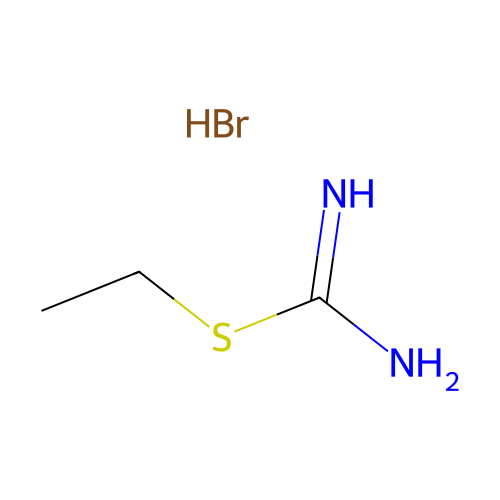
Deep product profile
S-Ethylisothiourea hydrobromide
- CAS No.
- 1071-37-0
- Product No.
- CB-00267
Product overview
S-Ethylisothiourea hydrobromide (CAS 1071-37-0) is identified as ethyl carbamimidothioate;hydrobromide. Its molecular formula is C3H9BrN2S and its molecular weight is 185.09.
CHEMDAD lists this reviewed record under Organosulfur Compounds. The reviewed representation is 2 disconnected components; the representation also contains amine, thioether, halogen substituent and no perceived rings.
Every displayed component, counterion and charge state forms part of the reviewed identity. Data for a free ligand, different salt or alternative stoichiometry are not interchangeable with this record.
Chemical identity
- IUPAC Name
- ethyl carbamimidothioate;hydrobromide
- Molecular Formula
- C3H9BrN2S
- Molecular Weight
- 185.09
- SMILES
- CCSC(=N)N.Br
- InChIKey
- SWXXKWPYNMZFTE-UHFFFAOYSA-N
Specification and supply
- Purity
- 98%
- Packaging
- On request
Technical information
Reviewed catalog fields
- Product number
- CB-00267
- Catalog category
- Organosulfur Compounds
- Formula
- C3H9BrN2S
- Molecular weight
- 185.09
- Purity
- 98%
- Packaging
- On request
Representation profile
- Structure components
- 2
- Formal charge
- 0
- Heavy atoms
- 7
- Perceived rings
- 0
- Specified atom stereocenters
- 0
Small-molecule hydrogen-bond, polar-surface-area, logP and rotatable-bond descriptors are withheld for this multi-component or metal-containing representation. Form-specific evaluation is required.
Document status
No batch-specific COA, SDS or analysis attachment is currently linked to this record. Request the current applicable documents for the intended lot before ordering, evaluation, storage or handling.
Calculated structure values describe the displayed representation and are not batch-release specifications. Public grade and purity values remain catalog values until confirmed by the applicable lot document.
Research and literature
Published research context
A process-development study used S-ethylisothiourea hydrobromide to construct an N1,N3-disubstituted 1,3,5-triazone intermediate through CDI activation, condensation, cyclization and N-alkylation. The authors reported a four-step telescoped gram-scale sequence and compared it with an earlier isocyanate route.
Reported research uses
- 1,3,5-Triazone ring-construction and heterocycle process-development research.
- Telescoped reaction studies combining CDI activation, condensation, cyclization and N-alkylation.
- Route-comparison work involving isothiourea salts and aminomethyl-triazole building blocks.
Reported technical observations
- The hydrobromide salt form controls formula, molecular weight and reaction stoichiometry and must not be replaced by free-base data.
- The reported gram-scale yield belongs to the cited reaction sequence and is not a guaranteed performance value for a CHEMDAD batch.
- Method transfer requires independent control of salt equivalents, base, solvent, water content, temperature and work-up.
These statements summarize the cited work for the exact reported compound or material. They are not CHEMDAD batch specifications, recommended manufacturing conditions, medical-use claims or guarantees of product performance.

 日本语
 한국어
 Français
 Deutsch
 España
 Türkiye