
Deep product profile
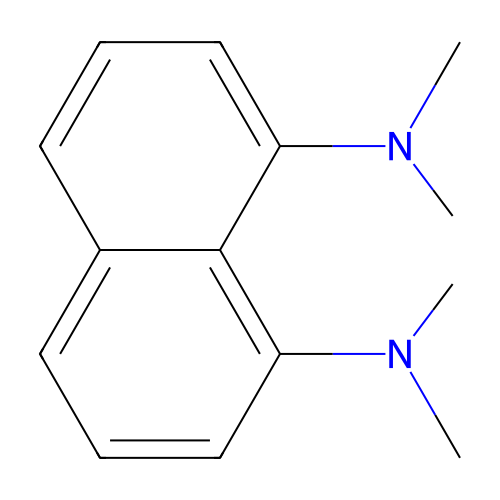
1,8-Bis(dimethylamino)naphthalene
- CAS No.
- 20734-58-1
- Product No.
- CS-00001
Product overview
1,8-Bis(dimethylamino)naphthalene (CAS 20734-58-1) is identified as 1-N,1-N,8-N,8-N-tetramethylnaphthalene-1,8-diamine. Its molecular formula is C14H18N2 and its molecular weight is 214.31.
CHEMDAD lists this reviewed record under Amines & Alcoholamines. The reviewed representation is a single-component structure with amine, aromatic ring system and 2 perceived rings (2 aromatic and 0 non-aromatic).
The exact name, CAS number and displayed molecular form control this record. Salts, stereoisomers, positional isomers, solvates, labeled analogues and formulations are different entities unless the page identifies them explicitly.
Chemical identity
- IUPAC Name
- 1-N,1-N,8-N,8-N-tetramethylnaphthalene-1,8-diamine
- Molecular Formula
- C14H18N2
- Molecular Weight
- 214.31
- SMILES
- CN(C)C1=CC=CC2=C1C(=CC=C2)N(C)C
- InChIKey
- GJFNRSDCSTVPCJ-UHFFFAOYSA-N
Specification and supply
- Purity
- 99% HPLC
- Packaging
- On request
Technical information
Reviewed catalog fields
- Product number
- CS-00001
- Catalog category
- Amines & Alcoholamines
- Formula
- C14H18N2
- Molecular weight
- 214.31
- Purity
- 99% HPLC
- Packaging
- On request
Calculated structure profile
- Structure components
- 1
- Exact mass
- 214.1470
- Hydrogen-bond donors
- 0
- Hydrogen-bond acceptors
- 2
- Rotatable bonds
- 2
- Topological polar surface area
- 6.48 Ų
- Calculated logP
- 2.97
- Fraction Csp3
- 0.29
- Formal charge
- 0
- Heavy atoms
- 16
- Perceived rings
- 2
- Specified atom stereocenters
- 0
These values are calculated from the displayed neutral or explicitly charged single-component SMILES representation. They are not batch-specific experimental specifications and do not establish solubility, solid-state form or process behavior.
Document status
No batch-specific COA, SDS or analysis attachment is currently linked to this record. Request the current applicable documents for the intended lot before ordering, evaluation, storage or handling.
Calculated structure values describe the displayed representation and are not batch-release specifications. Public grade and purity values remain catalog values until confirmed by the applicable lot document.
Research and literature
Published research context
A retained polymer-recycling study evaluates 1,8-bis(dimethylamino)naphthalene, commonly called proton sponge, as an organocatalyst for glycolysis of poly(ethylene terephthalate). Catalyst loading, ethylene-glycol equivalents, temperature and reaction time are examined, establishing an exact strong organic base and depolymerization context.
Reported research uses
- Organic-base catalysis and polyester chemical-recycling research.
- Poly(ethylene terephthalate) glycolysis and bis(hydroxyethyl) terephthalate production studies.
- Catalyst-loading, swelling, induction-time and depolymerization optimization.
Reported technical observations
- The 1,8-bis(dimethylamino) naphthalene architecture defines proton sponge; other aminonaphthalenes and protonated salts are different materials.
- Depolymerization yield belongs to the cited polymer feed and conditions and is not a catalyst specification.
- Method transfer requires control of polymer history, particle size, ethylene glycol, water, catalyst loading, temperature and isolation.
These statements summarize the cited work for the exact reported compound or material. They are not CHEMDAD batch specifications, recommended manufacturing conditions, medical-use claims or guarantees of product performance.

 日本语
 한국어
 Français
 Deutsch
 España
 Türkiye