
Deep product profile
Bismuth acetate
- CAS No.
- 22306-37-2
- Product No.
- ON-2243
Product overview
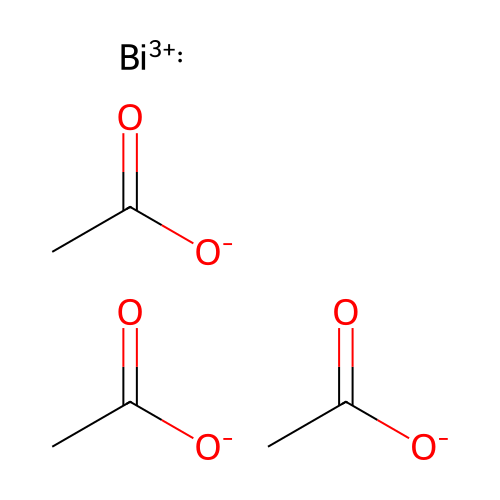
Bismuth acetate (CAS 22306-37-2) is identified as bismuth triacetate. Its molecular formula is C6H9BiO6 and its molecular weight is 386.11.
CHEMDAD lists this reviewed record under Metal Salts & Organometallics. The reviewed representation is 4 disconnected components, metal element Bi; the representation also contains carboxylate and no perceived rings.
Every displayed component, counterion and charge state forms part of the reviewed identity. Data for a free ligand, different salt or alternative stoichiometry are not interchangeable with this record.
Chemical identity
- IUPAC Name
- bismuth triacetate
- Molecular Formula
- C6H9BiO6
- Molecular Weight
- 386.11
- SMILES
- CC(=O)[O-].CC(=O)[O-].CC(=O)[O-].[Bi+3]
- InChIKey
- WKLWZEWIYUTZNJ-UHFFFAOYSA-K
Specification and supply
- Purity
- 99%
- Packaging
- On request
Technical information
Reviewed catalog fields
- Product number
- ON-2243
- Catalog category
- Metal Salts & Organometallics
- Formula
- C6H9BiO6
- Molecular weight
- 386.11
- Purity
- 99%
- Packaging
- On request
Representation profile
- Structure components
- 4
- Metal elements
- Bi
- Formal charge
- 0
- Heavy atoms
- 13
- Perceived rings
- 0
- Specified atom stereocenters
- 0
Small-molecule hydrogen-bond, polar-surface-area, logP and rotatable-bond descriptors are withheld for this multi-component or metal-containing representation. Form-specific evaluation is required.
Document status
No batch-specific COA, SDS or analysis attachment is currently linked to this record. Request the current applicable documents for the intended lot before ordering, evaluation, storage or handling.
Calculated structure values describe the displayed representation and are not batch-release specifications. Public grade and purity values remain catalog values until confirmed by the applicable lot document.
Research and literature
Published research context
A full experimental study charges bismuth acetate as the exact bismuth precursor in one-pot preparation of platinum-bismuth-cobalt alloy catalysts. The procedure combines defined masses of metal precursors, reducing agents, surfactant and mixed solvent before thermal treatment and evaluates the prepared alloys in electrochemical nitrate reduction.
Reported research uses
- Metal-precursor use in multimetallic alloy catalyst synthesis.
- One-pot colloidal preparation involving reduction, surfactant control and thermal processing.
- Catalyst-development studies that connect precursor ratios to alloy composition and electrochemical behavior.
Reported technical observations
- Bismuth acetate must be distinguished from bismuth nitrate, halides, oxides and basic acetate compositions.
- Electrochemical results belong to the prepared PtBi-Co alloy and electrode protocol, not to the bismuth precursor.
- Method transfer requires control of precursor assay, metal ratios, reducing agents, surfactant, temperature, washing and electrode loading.
These statements summarize the cited work for the exact reported compound or material. They are not CHEMDAD batch specifications, recommended manufacturing conditions, medical-use claims or guarantees of product performance.

 日本语
 한국어
 Français
 Deutsch
 España
 Türkiye