Other grades of this product :
| SULFENTRAZONE Basic information |
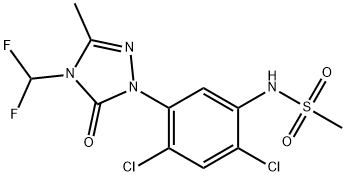
| Product Name: | SULFENTRAZONE | | Synonyms: | 2′,4′-dichloro-5′-(4-difluoromethyl-4,5-dihydro-3-methyl-5-oxo-1H-1,2,4-triazol-1-yl)methanesulfonanilide;N-(2,4-dichloro-5-(4-(difluoromethyl)-4,5-dihydro-3-methyl-5-oxo-1H-1,2,4-triazol-1-yl)phenyl)methanesulfonamide;SULFENTRAZONE,FMC 97285;Methanesulfonamide, N-2,4-dichloro-5-4-(difluoromethyl)-4,5-dihydro-3-methyl-5-oxo-1H-1,2,4-triazol-1-ylphenyl-;2',4'-dichloro-5'-(4-difluoromethyl-4,5-dihydro-3-methyl-5-oxo-1H-1,2,4-triazol-1-yl) methanesulfonanilide;Sulfentrazone standard;N-(2,4-dichloro-5-(4-(difluoroMethyl)-3-Methyl-5-oxo-4,5-dihydro-1H-1,2,4-triazol-1-yl)phenyl)MethanesulfonaMide;FREE SAMPLE NCV SULFENTRAZONE TECHNICAL | | CAS: | 122836-35-5 | | MF: | C11H10Cl2F2N4O3S | | MW: | 387.19 | | EINECS: | | Product Categories: | | Mol File: | 122836-35-5.mol |
| SULFENTRAZONE Chemical Properties |
| Melting point | 75-78° | | Boiling point | 468.2±55.0 °C(Predicted) | | density | 1.21 g/cm3 | | storage temp. | 0-6°C | | solubility | Chloroform (Slightly), Methanol (Slightly) | | pka | 6.56(at 25℃) | | form | Solid | | color | Pale Brown to Beige | | EPA Substance Registry System | Sulfentrazone (122836-35-5) |
| RIDADR | UN3077 (solid); UN3082(liquid) | | HS Code | 29350090 | | Hazardous Substances Data | 122836-35-5(Hazardous Substances Data) | | Toxicity | LD50 orally in rats: 2855 mg/kg; dermally in rabbits: >2000 mg/kg; LC50 (96 hr) in bluegill sunfish, rainbow trout (ppm): 92.8, >130 (Van Saun) |
| SULFENTRAZONE Usage And Synthesis |
| Description | Solubility. In water at 25 ?C: 100 mg/L at pH 6,
800 mg/mL at pH 7, 1,600 mg/mL at pH 7.5; soluble to
some extent in acetone and other polar organic solvents
Pka. 6.56
Stability. Stable | | Uses | Sulfentrazone is an herbicide used for controlling sedges in turfgrass. | | Uses | Herbicide. | | Trade name | AUTHORITY® Sulfentrazone; CANOPY XL®; COVER®; F6285®; FMC® 97285; GAUNTLET®; SPARTAN®; SULFENTRAZONE® (F6285) 4F; SULFENTRAZONE® (F6285) 75DF | | Metabolic pathway | When 14C-sulfentrazone is applied to coffee senna
and sicklepod through the roots, 83% of the parent
compound remains in coffee senna leaf tissue after
9 h exposure and in contrast, sicklepod takes up
relatively less sulfentrazone through the root and
metabolizes sulfentrazone in the foliage more rapidly
than coffee senna. The primary detoxification reaction
appears to be oxidation of the methyl group on the
triazolinone ring, resulting in the formation of the more
polar hydroxymethyl derivative. The aniline analog is
identified as a plant-specific metabolite. The tolerance
of sicklepod to sulfentrazone is primarily due to a
relatively high rate of metabolism of sulfentrazone
compared with coffee senna. When 14C-sulfentrazone
is administered orally to rats, goats, and hens in a
daily diet, administered radioactivity is quantitatively
excreted in the urine, feces, or hen excreta. In all of
the species, unchanged sulfentrazone and two non-conjugated metabolites are found, which are 3-hydroxymethyl and carboxylic acid derivatives, the
latter of which decomposes at high temperature or
acidic pH to give the corresponding desmethyl analog
of sulfentrazone. In rats, a minor reduction metabolite
is detected which is tentatively characterized as the
2,3-dihydro-3-hydroxymethyl derivative. |
| SULFENTRAZONE Preparation Products And Raw materials |
|


 日本语
日本语 한국어
한국어 Français
 Deutsch
 España
 Türkiye