Other grades of this product :
| Linsitinib Chemical Properties |
| Melting point | >175°C (dec.) | | density | 1.39 | | storage temp. | -20°C | | solubility | Soluble in DMSO (up to 30 mg/ml) | | form | solid | | pka | 14.84±0.40(Predicted) | | color | Yellow | | Stability: | Stable for 1 year from date of purchase as supplied. Solutions in DMSO may be stored at -20°C for up to 2 months. |
| Linsitinib Usage And Synthesis |
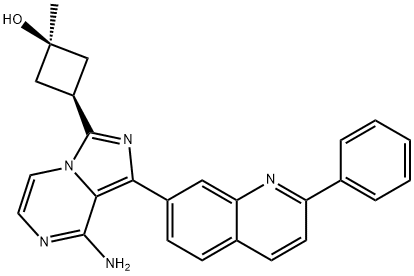
| Description | Linsitinib (OSI-906) is a selective inhibitor of IGF-1R with IC50 of 35 nM in cell-free assays; modestly potent to InsR with IC50 of 75 nM, and no activity towards Abl, ALK, BTK, EGFR, FGFR1/2, PKA etc. Phase 3. | | In vitro | OSI-906 inhibits IGF-1R autophosphorylation and activation of the downstream signaling proteins Akt, ERK1/2 and S6 kinase with IC50 of 0.028 to 0.13 μM. OSI-906 enables an intermediate conformation of the target protein through interactions with the C-helix. OSI-906 displays favorable metabolic stability in liver microsomes. OSI-906 fully inhibits both IR and IGF-1R phosphorylation at a concentration of 1 μM. OSI-906 inhibits proliferation of several tumor cell lines including non-small-cell lung cancer and colorectal cancer (CRC) tumor cell line with EC50 of 0.021 to 0.810 μM. | | In vivo | OSI-906 inhibits tumor growth in an IGF-1R-driven xenograft mouse model, with 100% TGI and 55% regression at a dose of 75 mg/kg and 60% TGI and no regression at a dose of 25 mg/kg. OSI-906 administration induces different elimination half-lives of itself in dog, rat and mice, the elimination half-lives are 1.18 hours, 2.64 hours and 2.14 hours, respectively. OSI-906 administration at different single dose once-daily in femal Sprague-Dawley rat and femal CD-1 mouse reveal that the Vmax is not dose-proportional to OSI-906 dose. OSI-906 elevates the blood glucose levels at a dose of 25 mg/kg after 12 days administration. OSI-906 administration at a single dose of 75 mg/kg in IGF-1R-driven full-length human IGF-1R (LISN) xenograft mouse model achieve maximal inhibition of IGF-1R phosphorylation (80%) between 4 and 24 hours with plasma drug concentrations of 26.6-4.77 μM. OSI-906 administered as a single dose of at 60 mg/kg in NCI-H292 xenografts mice inhibits uptake of glucose at 2, 4, and 24 hours post-treatment in vivo. OSI-906 inhibits the growth of tumors in NCI-H292 xenograft mouse model. | | Description | The binding of insulin-like growth factor 1 (IGF-1) to the IGF-1 receptor (IGF-1R) promotes cell growth while inhibiting apoptotic pathways. Overexpression of IGF-1R is found in certain solid tumors and hematologic neoplasias. However, insulin receptor (InsR) signaling can compensate for IGF-1R inhibition. Linsitinib is a dual inhibitor of IGF-1R and InsR kinases (IC50s = 35 and 75 nM, respectively). It also inhibits InsR-related receptor (IC50 = 75 nM) but is without effect (IC50 > 10 μM) against a large panel of other kinases. Linsitinib inhibits proliferation of a variety of tumor cell lines in vitro and has antitumor efficacy in an IGF-1R-driven xenograft mouse model when administered orally. A rapid, non-invasive method to predict the pharmacodynamic response to linsitinib has been reported. | | Uses | Linsitinib is a small-molecule dual insulin-like growth factor-1 receptor (IGF-IR) and insulin receptor (IR) kinase inhibitor. IGF-I receptor (IGF-IR) has been implicated in the promotion of tumorigenesis, metastasis and resistance to cancer therapies and thus Linsitinib may be a useful anticancer agent. | | Uses | Linsitinib is a small-molecule dual insulin-like growth factor-1 receptor (IGF-IR) and insulin receptor (IR) kinase inhibitor. IGF-I receptor (IGF-IR) has been implicated in the promotion of tumorigenesis, metastasis and resistance to cancer therapies and thus Linsitinib may be a useful anticancer agent. Potent IGF-1R inhibitor. | | References | 1) Mulvihill?et al.?(2009),?Discovery of OSI-906: a selective and orally efficacious inhibitor of the IGF-1 receptor and insulin receptor; Future Med. Chem.?1?1153
2) Bendell?et al.?(2015),?A phase Ib study of linsitinib (OSI-906), a dual inhibitor of IGF-1R and IR tyrosine kinase, in combination with everolimus as treatment for patients with refractory metastatic colorectal cancer; Invest. New Drugs?33?187
3) Pivonello?et al.?(2016),?The dual targeting of insulin and insulin-like growth factor 1 receptor enhances the mTOR inhibitor-mediated antitumor efficacy in hepatocellular carcinoma?; Oncotarget?7?9718
4) Lee?et al.?(2016),?Inhibition of IGF1R signaling abrogates resistance to afatinib (BIBW2992) in EGFR T790M mutant lung cancer cells; Mol. Carcinog.?55?991
5) Macaulay?et al.?(2016),?Phase I Dose-Escalation Study of Linsitinib (OSI-906) and Erlotinib in Patients with Advanced Solid Tumors; Clin. Cancer Res.?22?2897
6) De Lint?et al.?(2016),?Sensitizing Triple-Negative Breast Cancer to PI3K Inhibition by Cotargeting IGF1R; Mol. Cancer Ther.?15?1545 |
| Linsitinib Preparation Products And Raw materials |
|


 日本语
日本语 한국어
한국어 Français
 Deutsch
 España
 Türkiye