Other grades of this product :
| D-Thyroxine Basic information |
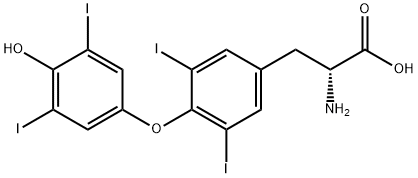
| Product Name: | D-Thyroxine | | Synonyms: | D-THYROXINE;3-[4-(P-HYDROXY-3,5-DIIODOPHENOXY)-3,5-DIIODOPHENYL]-D-ALANINE;DEBETROL;D-B-[(3 5-DIIODO-4-HYDROXYPHENOXY)-3 5-DIIODO-PHENYL]ALANINE;D-3,5-DIIODO-4-(3',5'-DIIODO-4'-HYDROXYPHENOXY)-PHENYLALANINE;D-3,3',5,5'-TETRAIODOTHYRONINE;D-3-[4-(4-HYDROXY-3,5-DIIODOPHENOXY)-3,5-DIIODOPHENYL]ALANINE;d-2-amino-3-[4-(4-hydroxy-3,5-diiodo-phenoxy)-3,5-diiodo-phenyl]-propanoic acid | | CAS: | 51-49-0 | | MF: | C15H11I4NO4 | | MW: | 776.87 | | EINECS: | 200-102-7 | | Product Categories: | Amino Acids & Derivatives;Aromatics;Intermediates & Fine Chemicals;Pharmaceuticals | | Mol File: | 51-49-0.mol |
| D-Thyroxine Chemical Properties |
| Melting point | ~235 °C (dec.) | | alpha | 21546 +2.97° (0.74 g in 6 g of 0.5N NaOH and 14 g of alcohol) | | Boiling point | 576.3±50.0 °C(Predicted) | | density | 2.4440 (estimate) | | storage temp. | Keep in dark place,Inert atmosphere,Store in freezer, under -20°C | | solubility | Acidic Alcohol (Slightly), Aqueous Acid (Slightly, Sonicated), Aqueous Base (Sli | | pka | 2.12±0.30(Predicted) | | form | Solid | | color | Off-White to Beige | | Stability: | Hygroscopic | | CAS DataBase Reference | 51-49-0(CAS DataBase Reference) |
| D-Thyroxine Usage And Synthesis |
| Chemical Properties | beige to light grey powder | | Originator | Choloxin,Knoll | | Uses | One of the thyroid hormones involved in the maintenance of metabolic homeostasis. Synthesized and stored as amino acid residues of thyroglobulin, the major protein component of the thyroid follicular colloid. Synthesis and secretion are regulated by the pituitary hormone (TSH). Deiodinated in peripheral tissues to the active metabolite, liothyronine. The D-form has very little activity as a thyroid hormone, but has been used to treat hyperlipidemia. | | Definition | ChEBI: The D-enantiomer of thyroxine. | | Manufacturing Process | The synthesis of dextrothyroxine includes 10 steps:1. 3-Iodo-5-nitro-4- [4-methoxy-phenoxy]benzaldehyde2. 2-Methyl-4-[3-iodo-5-nitro-(4-methoxy-phenoxy)-benzylidene]-4-H-oxazol5-one40 g above prepared derivate was heated with 12 g acetic acid and 10 g dry
sodium acetate in 70 ml acetic anhydride for 2.5 hours at 100°C. On cooling
the oxazolone precipitated. It was filtered off, washed with CCl4 and water;
next it was recrystallized from benzene. Yield 35 g. MP: 205°-206°C.
3. Methyl ester 3-iodo-5-nitro-4- [4-methoxy-phenoxy]-αacetylaminocinnamonic acid20 g the product from an item 2 was stirred with a solution of 1.2 g sodium in
200 ml methanol at 20°C. Soon the desirable ester began to fall. It was
filtered off after adding of 5 ml 95% acetic acid and recrystallized from 95%
acetic acid. Yield 18 g; MP: 216°C.4. Methyl ester 3-iodo-5-amino-4- [4-methoxy-phenoxy]-αacetylaminocinnamonic acid25 g Raney nickel was added to the suspension of 67 g above nitro ester in
450 ml methanol. Whereupon about 8.55 L hydrogen was passed (2 hours),
the hydrogenation product crystallized. It was filtered off. The catalyst was
removed by dissolving in tetrahydrofuran and repeated filtration. The solvent
was removed in vacuum. Yield 38 g; MP: 184°C (recrystallized from
methanol).5. Methyl ester 3,5-diiodo-4- [4-methoxy-phenoxy]-α-acetylaminocinnamonic
acid5 g the product from item 4 in 20 ml 95% acetic acid and 30 ml conc. H2SO4
was dropwise added to the solution of 1.1 g sodium nitrite in 15 ml conc.
H2SO4 and 30 ml conc. acetic acid. After 30 minutes the solution of diazonium
salt was added to the mixture of 3.5 g KI, 5.2 g I2 and 2.0 g urea in 250 ml
water and 30 ml CHCl3.The excessive iodine was removed with NaHSO3, an organic layer was
separated and distilled off to dryness. The residue was recrystallized from
acetic acid to yield 3.9 the desired product. MP: 209°C.150 ml acetaldehyde was dropwise added to 150 ml HI (d 1.70) by ice
cooling. Then 0.1 g FeSO4 and 18 g red phosphorous was added to 27 g
diiodo-derivate from the step 5. The mixture was heated to reflux about 20
minutes. Simultaneously methyl iodide was distilled off. Red phosphorous was
filtered off. The clear filtrate was distilled to dryness. The residue was
dissolved in 150 ml of hot water and 100 ml 2 N HCl. The conc. NH3 was
added. Precipitated product was washed with water, methanol and acetone
and dried. Yield 20.7 g (86%). MP: 256°C (decomp.).7. DL-N-Formyl-3,5-diiodothyronine100 g DL-3,5-Diiodothyronine was added to the mixture of 100 ml dry formic
acid and 50 ml acetic anhydride by stirring at ambient temperature to give the
clean solution. Soon DL-N-formyl-3,5-diiodothyronone begun to crystallize.
Yield 95 g. MP: 225°-230°C.8. (-)-D-N-Formyl-3,5-diiodothyronineThe above prepared DL-N-formyl-3,5-diiodothyronine was in 1500 ml of dry
isopropanol heated on a steam bath heated and the hot solution of 300 g dry
brucine in 1500 ml dry isopropanol was added. On cooling (+/-)-D- N-formyl3,5-diiodothyronone-brucine salt precipitated during 3 hours. 290 g this salt
was recrystallized from a mixture of 1 L dimethylformamide and 2.5 L
isopropanol. MP: 271°C. It was dropped into 750 ml 2 N NH3, four times with
methylene chloride extracted for brucine removing. Water-basic solution was
acidified to pH 2 with conc. HCl. (-)-D-N-Formyl-3,5-diiodothyronine
precipitated on cooling. Yield 140 g (96.5 %). MP: 186°C.9. (-)-D-3,5-Diiodothyronine
It was prepared from 100 g (-)-D-N-formyl-3,5-diiodothyronine and mixture of
1 L 48% HBr and water (1:2). Yield 80.5 g MP: 252°C (decomp.). [α]D20: -
25.0° (c=5, in 1 N HCL/95% ethanol 1:2)10. (-)-D-3,5,3',5'-Tetraiodothyronine (dextrothyroxine)9 g (-)-D-3,5-diiodothyronine was dissolved in 80 ml 40% methylamine by
stirring at room temperature. 34 ml 1 N iodine/KI was added slowly to this
solution. After 1.5 hours stirring, 150 ml NaCl solution was added and a
sodium salt precipitated. It was dissolved in mixture of 200 ml methanol and
20 ml 2 N HCl, and heated with an animal coal. The coal was filtered off and
neutralized with solution sodium acetate to pH 6. The precipitated was filtered
off, washed with methanol and acetone and dried. Yield of desired product 6.2
g; MP: 235°C; [α]D25:- 14.6° (c=5, in 1 N HCl/95% ethanol 1:2). | | Brand name | Choloxin (Abbott). | | Therapeutic Function | Thyroid hormone, Anticholesteremic | | Biological Functions | Dextrothyroxine, the synthetic D-(+)-stereoisomer isomer of L-(–)-T4, was introduced in hypocholesteremichypolipidemic therapy with the premise that it would be void of calorigenic effects. The possibility of trace
contamination with and metabolic conversion to T4 and congeners has restricted its use, however,
especially in patients with coronary heart disease. | | Mechanism of action | Dextrothyroxine speeds up the decomposition of cholesterol and lipoproteins, thus activating
catabolism of cholesterol in the liver, which results in cholesterol being more intensively
transformed into bile salts. It lowers the level of low-density lipoproteins in the
plasma and very low-density lipoproteins in fatty tissue. It is recommended for treating
hyperlipoproteinemia. | | Purification Methods | Recrystallise D-thyroxine from H2O (needles) or from an ammonical solution by dilution with H2O, MeOH or Me2CO. It has also been purified by dissolving ~6.5 g in a mixture of MeOH (200mL) and 2N HCl (20mL), adding charcoal, filtering then adding NaOAc solution to pH 6. On standing the thyroxine separates, it is filtered off, washed with MeOH then Me2CO and dried in vacuo. N-Formyl-D-thyroxine has m 210o and [] 21 -26.9o (c 5, EtOH). (±)-Thyroxine has m 256o and is purified in the same way. [Nahm & Siedel Chem Ber 96 1 1963, Salter Biochem J 24 471 1930, Beilstein 14 I 671, 14 II 384, 14 III 1566, 14 IV 2374.] |
| D-Thyroxine Preparation Products And Raw materials |
|


 日本语
日本语 한국어
한국어 Français
 Deutsch
 España
 Türkiye