Other grades of this product :
| D-MANNOHEPTULOSE Basic information |
| D-MANNOHEPTULOSE Chemical Properties |
| Melting point | 148-150°C | | alpha | D20 +29° (c = 2 in H2O) | | Boiling point | 628.0±55.0 °C(Predicted) | | density | 1.645±0.06 g/cm3(Predicted) | | storage temp. | Refrigerator | | solubility | Methanol (Slightly), Water (Slightly) | | form | Solid | | pka | 11.86±0.20(Predicted) | | color | White to Off-White | | Merck | 13,4686 | | BRN | 1726433 | | EPA Substance Registry System | D-manno-2-Heptulose (3615-44-9) |
| Safety Statements | 24/25 | | WGK Germany | 2 | | HS Code | 29400090 |
| D-MANNOHEPTULOSE Usage And Synthesis |
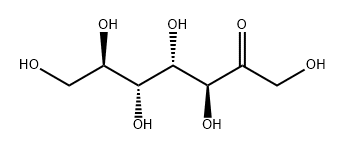
| Description | D-Glucose is phosphorylated by glucokinase and three tissue-specific hexokinases to produce glucose-6-phosphate in humans. D-Mannoheptulose is a heptose that inhibits glucokinases and hexokinases from diverse organisms through competition with D-glucose (Ki = 0.25 mM). It blocks glucose oxidation and glucose-mediated insulin release from pancreatic islet cells. D-Mannoheptulose prevents the conversion of glucose to glucose-6-phosphate that can mediate the activation of the carbohydrate response element binding protein. By blocking glucose phosphorylation, D-mannoheptulose causes transient hyperglycemia in dogs when given at 1 g/kg but not at 8 mg/kg, although postprandial energy expenditure is increased at the lower dose. | | Chemical Properties | White Solid | | Uses | Mannoheptulose occurs naturally in avocado fruit. It is used for normalizing insulin levels and reducing weight. | | Uses | Mannoheptulose occurs naturally in avocado fruit. |
| D-MANNOHEPTULOSE Preparation Products And Raw materials |
|


 日本语
日本语 한국어
한국어 Français
 Deutsch
 España
 Türkiye