Other grades of this product :
| 5,5'-(2,5-FURANDIYL)BIS-2-THIOPHENEMETHANOL Basic information |
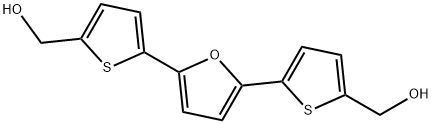
| Product Name: | 5,5'-(2,5-FURANDIYL)BIS-2-THIOPHENEMETHANOL | | Synonyms: | 5,5'-(2,5-FURANDIYL)BIS-2-THIOPHENEMETHANOL;p53 Activator III;RITA (NSC 652287);(5,5'-(furan-2,5-diyl)bis(thiophene-5,2-diyl))diMethanol;2-Thiophenemethanol, 5,5'-(2,5-furandiyl)bis-;5,5'-(2,5-Furandiyl)bis-2-thiophenemethanol RITA (NSC 652287);5,5'-(2,5-Furandiyl)bis-2-thiophenemethanol
NSC 652287;NSC 652287 5,5'-(2,5-Furandiyl)bis-2-thiophenemethanol | | CAS: | 213261-59-7 | | MF: | C14H12O3S2 | | MW: | 292.37 | | EINECS: | 200-256-5 | | Product Categories: | Inhibitor;Inhibitors | | Mol File: | 213261-59-7.mol |
| 5,5'-(2,5-FURANDIYL)BIS-2-THIOPHENEMETHANOL Chemical Properties |
| Melting point | 160 °C | | Boiling point | 464.9±40.0 °C(Predicted) | | density | 1.396±0.06 g/cm3(Predicted) | | storage temp. | Keep in dark place,Sealed in dry,Store in freezer, under -20°C | | solubility | Soluble in DMSO (up to 20 mg/ml) | | form | Crystalline solid | | pka | 13.43±0.10(Predicted) | | color | Yellow | | Sensitive | Light Sensitive | | Stability: | Stable for 2 years as supplied. Solutions in DMSO may be stored at -20°C for up to 3 months. |
| 5,5'-(2,5-FURANDIYL)BIS-2-THIOPHENEMETHANOL Usage And Synthesis |
| Description | RITA (reactivation of p53 and induction of tumor cell apoptosis, 213261-59-7) binds to p53 (Kd = 1.5 nM), changing its conformation, preventing it from binding to HDM2 and preventing its proteasomal degradation.1 It also weakly (computed Kd = 22 μM) binds HDM2 in the cleft that contacts the p53 transactivation domain.2 Its restoration of mutant p53 function depends on eIF2α phosphorylation, and it induces apoptosis via p53-dependent and -independent (JNK/SAPK/p38; protein translation) pathways.3-5 Induces senescence in head and neck cancer cells.6 | | Uses | NSC 652287, a DNA damaging agent. It induces p53 tumor suppressor protein. | | Uses | A cell-permeable, p53-targeting, tricyclic thiophene derivative | | Biological Activity | Anti-tumor agent that binds wild-type p53 (K d = 1.5 nM) preventing p53-MDM2 (HDM2) interaction. Induces p53 accumulation and stimulates apoptosis in tumor cell lines expressing wild-type p53 in vitro and in vivo . | | in vitro | a number of cell lines showed a striking differential sensitivity to nsc 652287 when compared with the other cell lines in the panel, with gi50 values of 10–60 nm. the compound was found to decrease the initial number of cells by 50% (lc50) at a concentration of 100 nm in the a-498 cell line, compared with ~100 mm for the majority of the tumor cell lines. the a-498 and tk-10 cell lines were particularly sensitive to nsc 652287-induced cytotoxicity compared with achn and uo-31 cell lines [1]. | | in vivo | nsc 652287 was evaluated against a-498 tumor cell xenografts grown subcutaneously in nude mice. when nsc 652287 was administered twice a day, all three doses resulted in complete tumor regression in 100% of the treated mice by the end of the third treatment period. the tumors did not regrow during the remaining 40 days of the study, and no gross evidence of toxicity was observed. studies with xenografts derived from other sensitive cell lines including the renal caki-1, melanoma uacc-257, ovarian ovcar-5, and colon hcc-2998, showed moderate or minimal in vivo activity [2]. | | IC 50 | 2 nm and 20 nm for a-498 and tk-10, respectively | | References | Issaeva et al. (2004), Small molecule RITA binds to p53, blocks p53-HDM-2 interaction and activates p53 function in tumors; Nat. Med., 10 1321
Espinoza-Fonseca et al. (2005), Targeting MDM2 by the small molecule RITA: towards the development of new multi-target drugs against cancer; Theor. Biol. Med. Model, 2 38
Ristau et al. (2019), RITA requires eIF2α-dependent modulation of mRNA translation for its anti-cancer activity; Cell Death Dis., 10 845
Zhao et al. (2010), Rescue of the apoptotic-inducing function of mutant p53 by small molecule RITA; Cell Cycle, 9 1847
Weilbacher et al. (2014), RITA can induce cell death in p53-defective cells independently of p53 function via activation of JNK/SAPK and p38; Cell Death Dis., 5 e1318
Chuang et al. (2014), The p53-reactivating small molecule RITA induces senescence in head and neck cancer cells.; PLoS One, 9(8) e104821 |
| 5,5'-(2,5-FURANDIYL)BIS-2-THIOPHENEMETHANOL Preparation Products And Raw materials |
|


 日本语
日本语 한국어
한국어 Français
 Deutsch
 España
 Türkiye