Other grades of this product :
| Debio-1347 Basic information |
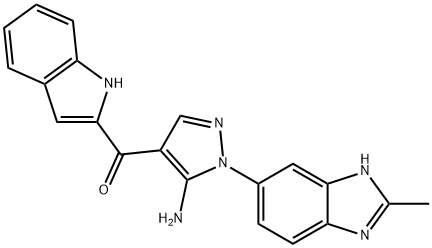
| Product Name: | Debio-1347 | | Synonyms: | Debio-1347;FF284;CH5183284 (Debio-1347);(5-amino-1-(2-methyl-3H-benzo[d]imidazol-5-yl)-1H-pyrazol-4-yl)(1H-indol-2-yl)methanone;CH5183284;Debio-1347:CH5183284;CH5183284;CH-5183284;CH 5183284;CS-1637 | | CAS: | 1265229-25-1 | | MF: | C20H16N6O | | MW: | 356.38 | | EINECS: | | Product Categories: | Inhibitors;API | | Mol File: | 1265229-25-1.mol |
| Debio-1347 Chemical Properties |
| Boiling point | 775.5±55.0 °C(Predicted) | | density | 1.51±0.1 g/cm3(Predicted) | | solubility | ≥35.6 mg/mL in DMSO; insoluble in EtOH; insoluble in H2O | | form | solid | | pka | 10.51±0.10(Predicted) | | CAS DataBase Reference | 1265229-25-1 |
| Debio-1347 Usage And Synthesis |
| Uses | CH5183284 is an orally available and selective FGFR (fibroblast growth factor receptor) inhibitor acting on FGFR 1, 2, and 3. | | Biological Activity | ch5183284 (debio-1347) is a selective and novel inhibitor of fgfr with ic50 value of 9.3, 7.6, 22 and 290 nm for fgfr1, fgfr2, fgfr3 and fgfr4, respectively [1].fibroblast growth factor receptors (fgfrs) are tyrosine kinases and receptors for fibroblast growth factors and consist of fgfr1, fgfr2, fgfr3 and fgfr4. in cancer, fgfr is activated by point mutations, gene amplification or chromosomal translocations/rearrangements and is involved in angiogenesis, cell growth, cell migration, invasion and metastasis [1].ch5183284 (debio-1347) is a selective and novel fgfr inhibitor. in a competitive binding assay, ch5183284 (debio-1347) binding with fgfr1, fgfr2, fgfr3, fgfr4 and kdr with kd values of 20, 20, 25, 740 and 960 nm, respectively. in dms114, snu-16 and kms11 cell lines, ch5183284 (debio-1347) (100-300 nm) inhibited autophosphorylation of fgfr1, fgfr2 and fgfr3. in cancer cell lines with the fgfr genetic alterations, ch5183284 (debio-1347) showed antiproliferative activity [1].in xenograft mouse models, ch5183284 (debio-1347) inhibited tumor growth against xenografts with fgfr genetic alterations such as kg1 (leukemia, fgfr1op-fgfr1 fusion), mfe-280 (endometrial cancer, fgfr2 s252w mutation), snu-16 (gastric cancer, fgfr2 amplification), rt112/84 (bladder cancer, fgfr3-tacc3 fusion) and um-uc-14 (bladder cancer, fgfr3 s249c mutation) by 134%, 100%, 147%, 125% and 116%, respectively [1]. | | Synthesis | The synthesis of Debio-1347 is as follows:An aqueous solution (1.67 ml) of 4 M sodium hydroxide was added to an ethanol solution (17 ml) of [5-amino-1-(2-methyl-1H-benzimidazol-5-yl)-1H-pyrazol-4-yl]-(1-benzenesulfonyl-1H-indol-2-yl) methanone (87 mg). The resulting mixture was stirred at room temperature for 2 hours. The reaction mixture was poured into water. The resulting solid was collected by filtration, washed with water, and dried to give Debio-1347 (40 mg, 63%). | | references | [1]. nakanishi y, akiyama n, tsukaguchi t, et al. the fibroblast growth factor receptor genetic status as a potential predictor of the sensitivity to ch5183284/debio 1347, a novel selective fgfr inhibitor. mol cancer ther, 2014, 13(11): 2547-2558. |
| Debio-1347 Preparation Products And Raw materials |
|


 日本语
日本语 한국어
한국어 Français
 Deutsch
 España
 Türkiye