Other grades of this product :
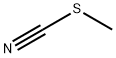
| Methyl thiocyanate Basic information |
| Product Name: | Methyl thiocyanate | | Synonyms: | Methylethiocyanate;Methyl thiocyanate,99%;Methyl thiocyanate, 99% 100ML;thiocyanatoMethane;Methyl Rhodanide
Thiocyanic Acid Methyl Ester;CH3SCN;Methane, thiocyanato-;Methyl sulfocyanate | | CAS: | 556-64-9 | | MF: | C2H3NS | | MW: | 73.12 | | EINECS: | 209-134-6 | | Product Categories: | | Mol File: | 556-64-9.mol |
| Methyl thiocyanate Chemical Properties |
| Provider | Language |
|
ACROS
| English |
| Methyl thiocyanate Usage And Synthesis |
| Chemical Properties | CLEAR COLOURLESS TO LIGHT YELLOW LIQUID | | Chemical Properties | Methyl thiocyanate is a colorless liquid.
Onion-like odor | | Definition | ChEBI: Methyl thiocyanate is a member of the class of thiocyanates, being the methyl ester of thiocyanic acid. | | General Description | Colorless liquid and an odor of onions. Used as an agricultural insecticide, a fumigant and as a research chemical. No evidence of commercial production in the U.S. | | Air & Water Reactions | Very slightly soluble in water [Merck]. | | Reactivity Profile | Methyl thiocyanate is a moderately toxic liquid, flammable. Violent, possibly explosive oxidation reaction when mixed with chlorates, nitrates, nitric acid, organic or inorganic peroxides, perchlorates. On contact with mineral acids or acid fumes deadly toxic hydrogen cyanide gas is produced. When heated to decomposition or on contact with mineral acids Methyl thiocyanate emits highly toxic fumes of nitriles, oxides of sulfur and nitrogen [Lewis, 3rd ed., 1993, p. 879, 1234]. | | Health Hazard | Methyl thiocyanate is highly toxic if ingested. It is a rapidly acting poison. | | Fire Hazard | When heated to decomposition, Methyl thiocyanate emits very toxic fumes of oxides of nitrogen and sulfur. (Non-Specific -- Thiocyanates) Incompatible with nitric acid. Violent reactions have occurred when mixed with chlorates, nitrates, nitric acid, organic peroxides, peroxides, potassium chlorate, and sodium chlorate. Methyl thiocyanate is volatile. | | Safety Profile | Poison by ingestion,
intravenous, and subcutaneous routes.
When heated to decomposition it emits very
toxic fumes of NOx and SOx. | | Potential Exposure | It is used as an agricultural insecticide; a fumigant; and as a research chemical. No evidence
of commercial production in the United States. | | Shipping | UN2929 Toxic liquids, flammable, organic,
n.o.s., Hazard class: 6.1; Labels: 6.1-Poison Inhalation
Hazard, 3-Flammable liquid, Technical Name Required.
UN1992 Flammable liquids, toxic, n.o.s., Hazard Class: 3;
Labels: 3-Flammable liquid, 6.1-Poisonous materials,
Technical Name Required. | | Incompatibilities | Incompatible with nitric acid. Violent
reactions have occurred when mixed with chlorates,
nitrates, nitric acid; peroxides, potassium chlorate; and
sodium chlorate. |
| Methyl thiocyanate Preparation Products And Raw materials |
|

 日本语
日本语 한국어
한국어 Français
 Deutsch
 España
 Türkiye