Other grades of this product :
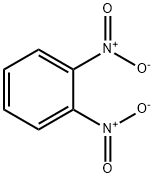
| 1,2-Dinitrobenzene Basic information |
| 1,2-Dinitrobenzene Chemical Properties |
| Melting point | 116 °C | | Boiling point | 319 °C773 mm Hg(lit.) | | density | 1.57 | | refractive index | 1.5650 | | Fp | 150 °C | | solubility | chloroform: soluble5%, clear, yellow-green | | form | neat | | color | Colorless to yellow needles | | Water Solubility | 150 mg/L (20 ºC) | | Merck | 14,3273 | | BRN | 642224 | | Exposure limits | NIOSH REL: TWA 1, IDLH 50; OSHA PEL: TWA 1; ACGIH TLV:
TWA 0.15 ppm for all isomers (adopted). | | CAS DataBase Reference | 528-29-0(CAS DataBase Reference) | | NIST Chemistry Reference | Benzene, 1,2-dinitro-(528-29-0) | | EPA Substance Registry System | o-Dinitrobenzene (528-29-0) |
| 1,2-Dinitrobenzene Usage And Synthesis |
| Chemical Properties | light yellow-brown powder | | Uses | 1,2-Dinitrobenzene was used as internal standard for analysis of the explosives, TNT, RDX, and tetryl in sea water by vapor phase chromatography with the nickel-63 electron capture detector. | | Synthesis Reference(s) | The Journal of Organic Chemistry, 21, p. 1065, 1956 DOI: 10.1021/jo01116a003 | | General Description | Colorless to yellow solid. Sinks and slowly mixes with water. | | Air & Water Reactions | Slowly mixes with water. | | Reactivity Profile | All three isomers have similar properties and may react vigorously with oxidizing materials. Their reaction with nitric acid (nitration) will lead to a mixture of trinitrobenzenes possessing high-explosive properties [Urbanski, 1967, vol. 3, p. 290]. If heat and reaction conditions of the nitration are not controlled, detonation comparable to TNT may occur [Anon., J. R. Inst. Chem., 1960, 84, p. 451]. Mixture of 1,3-dinitrobenzene with tetranitromethane was found highly explosive [Urbanski, 1964, vol. 1, 592]. 1,2-dinitrobenzene is a severe explosion hazard when shocked or exposed to heat or flame. When heated to decomposition all dinitrobenzens emit toxic fumes of nitrogen oxides [Sax, 9th ed., 1996, p. 1374]. | | Health Hazard | INHALATION, INGESTION, OR SKIN ABSORPTION: Headache, vertigo and vomiting followed by exhaustion, numbness of the legs, staggering and collapse. Intense methemoglobinenia may lead to asphyxia severe enough to injure the CNS. EYES: Irritation. SKIN: Stains skin yellow. | | Safety Profile | Suspected carcinogen.
Poison by inhalation and ingestion.
Moderately toxic by sktn contact. Can cause
liver, kidney, and central nervous system
injury. Combustible when exposed to heat
or flame; can react vigorously with oxidzing
materials. A severe explosion hazard when
shocked or exposed to heat or flame. It is
used in bursting charges and to fiu artillery
shells. Mixtures with nitric acid are highly
explosive. To fight fire, use water, Co2, dry
chemical. Dangerous; when heated to
decomposition it emits highly toxic fumes of
NO, and explodes. See also mand pDINITROBENZENE and NITRO
COMPOUNDS of AROMATIC
HYDROCARBONS. | | Environmental fate | Biological. Under anaerobic and aerobic conditions using a sewage inoculum, 1,2-dinitrobenzene degraded to nitroaniline (Hallas and Alexander, 1983).
Photolytic. Low et al. (1991) reported that the nitro-containing compounds (e.g., 2,4-
dinitrophenol) undergo degradation by UV light in the presence of titanium dioxide yielding
ammonium, carbonate, and nitrate ions. By analogy, 1,2-dinitrobenzene should degrade forming
identical ions.
Chemical/Physical. Releases toxic nitrogen oxides when heated to decomposition (Sax and
Lewis, 1987). 1,2-Dinitrobenzene will not hydrolyze in water (Kollig, 1993). | | Purification Methods | Crystallise it from EtOH. [Beilstein 5 IV 738.] |
| 1,2-Dinitrobenzene Preparation Products And Raw materials |
| Raw materials | Copper-->2-Nitroaniline-->Sodium tetrafluoroborate | | Preparation Products | 1,3-Dinitrobenzene-->SULFATE STANDARD-->N,N-Dimethylaniline-->1,2,3,4-tetrahydro-Phenazine-->1-(2-NITROPHENYL)PIPERIDINE-->(3-NITROPHENYL)ACETIC ACID METHYL ESTER-->DIBENZO-P-DIOXIN-->1,2-Benzenedicarbonitrile, 4,5-diamino--->3-AMINO-1,2,4-BENZOTRIAZINE-1,4-DIOXIDE-->2,5-DINITROBENZOIC ACID-->FUBERIDAZOLE |
|


 日本语
日本语 한국어
한국어 Français
 Deutsch
 España
 Türkiye