Other grades of this product :
| 3-Aminopropionitrile Basic information |
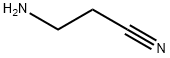
| Product Name: | 3-Aminopropionitrile | | Synonyms: | 3-AMINOPROPIONITRILE , STABILIZED WITH POTASSIUM CARBONATE;3-AMINOPROPIONITRILE (BETA-) 98+%;3-AMINOPROPIONITRILE, 98%, STAB. WITH POTASSIUM CARBONATE;3-Aminopropionitrile, 98%, stabilized;β-Aminopropanenitrile;B-AMINOPROPIONITRILE;BETA-AMINOPROPIONONITRILE;BETA-AMINOETHYL CYANIDE | | CAS: | 151-18-8 | | MF: | C3H6N2 | | MW: | 70.09 | | EINECS: | 205-786-0 | | Product Categories: | | Mol File: | 151-18-8.mol |
| 3-Aminopropionitrile Chemical Properties |
| Melting point | <25 °C | | Boiling point | 185 °C | | density | 0.9584 | | refractive index | 1.4365-1.4395 | | Fp | 79-81°C/16mm | | storage temp. | Keep in dark place,Inert atmosphere,2-8°C | | solubility | Chloroform, Methanol | | form | Liquid | | pka | 7.80(at 20℃) | | color | Clear colorless to yellow | | Water Solubility | Soluble in water. | | Sensitive | Air & Moisture Sensitive | | Merck | 14,469 | | BRN | 1698848 | | InChIKey | AGSPXMVUFBBBMO-UHFFFAOYSA-N | | CAS DataBase Reference | 151-18-8(CAS DataBase Reference) | | EPA Substance Registry System | Propanenitrile, 3-amino- (151-18-8) |
| 3-Aminopropionitrile Usage And Synthesis |
| Chemical Properties | clear colourless to yellow liquid | | Uses | Production of β-alanine and pantothenic acid. | | Uses | 3-Aminopropionitrile is used for organic synthesis and as pharmaceutical intermediates. As an intermediate used in the manufacture of beta-alanine and pantothenic acid. | | Definition | ChEBI: An aminopropionitrile carrying an amino group at the beta-position. | | Safety Profile | Moderately toxic by intraperitoneal route. An experimental teratogen. Other experimental reproductive effects. Mutation data reported. Nitriles usually have cyanide-like effects. See also CYANIDE. Easily oxidized and unstable. A storage hazard; it polymerizes to an explosive yellow solid. When heated to decomposition it emits toxic fumes of CNand NO,. For fire and explosion hazards see CYANIDE. | | Metabolism | 3-Aminopropionitrile is the compound present in some Lathyms species (Leguminosae), especially sweet-pea seeds (L. odoratus), causing osteolathyrism in man and animals. Although 3-aminopropionitrile is generally present in the fresh plant as the gama-glutamyl derivative, only the free amine is an effective lathyrogen.
Osteolathyrogens cause skeletal deformations due to interference with the cross-linking between polypeptide chains in the connective tissue components, elastin and collagen. This interference is partly due to inhibition of the synthesis of desmosine and isodesmosine, amino acids which effect the cross-linking in elastin. Cross-linking interference of collagen can be prevented in chicks by feed- ing excess calcium.
It is possible that 3-aminopropionitrile is adegradation product of 3-cyano-alanine, although in many plants the latter compound is converted to asparagine and it has not been detected in Lathyms species. |
| 3-Aminopropionitrile Preparation Products And Raw materials |
|


 日本语
日本语 한국어
한국어 Français
 Deutsch
 España
 Türkiye