Other grades of this product :
| DIMETHYLCYANAMIDE Basic information |
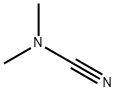
| Product Name: | DIMETHYLCYANAMIDE | | Synonyms: | N-Cyanodimethylamide;(CH3)2NCequivN;dimethyl-carbamonitrile;dimethyl-cyanamid;Dimethylkyanamid;n-cyanodimethylamine;N-Cyano-N-methylmethanamine;DIMETHYLCYANAMIDE | | CAS: | 1467-79-4 | | MF: | C3H6N2 | | MW: | 70.09 | | EINECS: | 215-991-7 | | Product Categories: | | Mol File: | 1467-79-4.mol |
| DIMETHYLCYANAMIDE Chemical Properties |
| Melting point | -41 °C | | Boiling point | 161-163 °C(lit.) | | density | 0.867 g/mL at 25 °C(lit.) | | refractive index | n20/D 1.41(lit.) | | Fp | 137 °F | | storage temp. | Inert atmosphere,2-8°C | | solubility | Chloroform (Sparingly), Hexane (Slightly) | | form | Liquid | | pka | -4.76±0.70(Predicted) | | color | Clear colorless to yellow | | EPA Substance Registry System | Dimethylcyanamide (1467-79-4) |
| DIMETHYLCYANAMIDE Usage And Synthesis |
| Chemical Properties | CLEAR COLORLESS TO YELLOWISH LIQUID | | Uses | Dimethylcyanamide in the presence of tetrachlorosilane and zinc chloride is used as a promoter for one-pot, three component synthesis of a novel series of 1,3-oxazines. Being a dialkylcyanamide, it has been proved to be a more reactive substrate toward metal-mediated nucleophilic addition than alkylcyanides. | | Production Methods | Dimethyl cyanamide is made by the reaction of nitromethane
with tris(dimethylamino) arsine. | | General Description | Clear liquid. | | Air & Water Reactions | Reacts with water to form cyanide gas | | Reactivity Profile | Nitriles, such as DIMETHYLCYANAMIDE, may polymerize in the presence of metals and some metal compounds. They are incompatible with acids; mixing nitriles with strong oxidizing acids can lead to extremely violent reactions. Nitriles are generally incompatible with other oxidizing agents such as peroxides and epoxides. The combination of bases and nitriles can produce hydrogen cyanide. Nitriles are hydrolyzed in both aqueous acid and base to give carboxylic acids (or salts of carboxylic acids). These reactions generate heat. Peroxides convert nitriles to amides. Nitriles can react vigorously with reducing agents. Acetonitrile and propionitrile are soluble in water, but nitriles higher than propionitrile have low aqueous solubility. They are also insoluble in aqueous acids. DIMETHYLCYANAMIDE reacts with oxidizers, water, or steam. | | Health Hazard | ACUTE/CHRONIC HAZARDS: DIMETHYLCYANAMIDE is an irritant. It reacts with water to produce toxic and flammable vapors. | | Fire Hazard | DIMETHYLCYANAMIDE is combustible. | | Safety Profile | Poison by ingestion,
skin contact, and intraperitoneal routes.
Moderately toxic by inhalation. Flammable
when exposed to heat, flame, or oxidzers.
Can react with oxidzing materials. To fight
fire, use foam, CO2, or dry chemical. When
heated to decomposition or in reaction with
water or steam it produces toxic fumes of
NOx, and CNand flammable vapors. See
also CYANIDE |
| DIMETHYLCYANAMIDE Preparation Products And Raw materials |
|


 日本语
日本语 한국어
한국어 Français
 Deutsch
 España
 Türkiye