Other grades of this product :
| Roxarsone Basic information |
| Roxarsone Chemical Properties |
| Melting point | ≥300 °C(lit.) | | Boiling point | 537.3±60.0 °C(Predicted) | | density | 2.02 g/cm3 | | storage temp. | 0-6°C | | solubility | insoluble in Ether | | pka | 3.51±0.10(Predicted) | | form | liquid | | color | Light yellow to Yellow | | Water Solubility | <0.1 g/100 mL at 23 ºC | | Merck | 14,8273 | | BRN | 1976533 | | InChIKey | XMVJITFPVVRMHC-UHFFFAOYSA-N | | CAS DataBase Reference | 121-19-7(CAS DataBase Reference) | | EPA Substance Registry System | Roxarsone (121-19-7) |
| Roxarsone Usage And Synthesis |
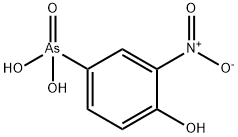
| Chemical Properties | BEIGE-BROWN FINE CRYSTALLINE POWDER | | Uses | antiinfective, preservative | | Uses | 4-Hydroxy-3-nitrophenylarsonic Acid is used as a feed additive for chicken to aid in the prevention of coccidiosis caused by E[imeria] tenella and E. necatrix. | | Uses | Formerly in manufacture of arsphenamines; as reagent for zirconium. | | Definition | ChEBI: An organoarsonic acid where the organyl group is 4-hydroxy-3-nitrophenyl. | | General Description | Pale yellow crystals or light tan powder. | | Air & Water Reactions | Insoluble in water. | | Reactivity Profile | May be sensitive to light and elevated temperatures on long-term storage. Roxarsone puffs up and deflagrates on heating. Incompatible with strong oxidizers and strong acids. Forms mono-, di-, and trisodium salts. | | Hazard | Toxic by ingestion, highly toxic. | | Fire Hazard | Flash point data are not available for Roxarsone ; however, Roxarsone is probably combustible. | | Purification Methods | It crystallises from water and is used for the spectroscopic detection of Zn. [Beilstein 16 II 468, 16 III 1073, 16 IV 1188.] |
| Roxarsone Preparation Products And Raw materials |
|


 日本语
日本语 한국어
한국어 Français
 Deutsch
 España
 Türkiye