Other grades of this product :
| 1,4-DINITROBENZENE Basic information |
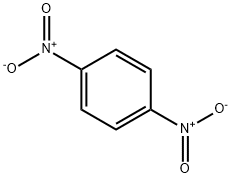
| Product Name: | 1,4-DINITROBENZENE | | Synonyms: | 1,4-DINITROBENZENE;1,4-Dinitrobenzenn;P-DINITROBENZENE;p-1,4 dinitrobenzene;1,4-DINITROBENZENE, 1X1ML, MEOH, 2000UG/ ML;1,4-DINITROBENZENE OEKANAL, 250 MG;1,4-Dinitrobenzene, 98+%;1,4-dinitrlbenzene | | CAS: | 100-25-4 | | MF: | C6H4N2O4 | | MW: | 168.11 | | EINECS: | 202-833-7 | | Product Categories: | Aromatic Hydrocarbons (substituted) & Derivatives;Miscellaneous;Volatiles/ Semivolatiles;AromaticsAlphabetic;DID - DINAnalytical Standards;Environmental Standards;Alpha Sort;Analytical Standards;AromaticsVolatiles/ Semivolatiles;Chemical Class;D;DAlphabetic;Nitro CompoundsChromatography;Solid Waste;Nitro Compounds;Nitrogen Compounds;Organic Building Blocks;DID - DIN | | Mol File: | 100-25-4.mol |
| 1,4-DINITROBENZENE Chemical Properties |
| Melting point | 170-173 °C(lit.) | | Boiling point | 183.4 °C34 mm Hg(lit.) | | density | 1.625 g/mL at 25 °C(lit.) | | vapor pressure | 2.25 x 10⁻⁴ mmHg at 35 °C (Hine et al., 1963) | | refractive index | 1.725 (589.3 nm) | | Fp | 150 °C | | storage temp. | Store below +30°C. | | solubility | alcohol: soluble1g in 300ml | | form | Crystals or Powder | | color | Ochre to orange | | Water Solubility | Soluble in water. (0.8 g/L) at 20°C. | | Merck | 14,3273 | | BRN | 1105828 | | Henry's Law Constant | 4.79(x 10-7 atm?m3/mol) at 35 °C (approximate - calculated from water solubility and vapor pressure) | | Exposure limits | NIOSH REL: TWA 1, IDLH 50; OSHA PEL: TWA 1 ACGIH TLV:
TWA 0.15 ppm for all isomers (adopted). | | Stability: | Stable, but may be shock-sensitive. May explode if heated. Incompatible with oxidizing agents, strong bases, nitric acid, many metals, tin oxides. | | CAS DataBase Reference | 100-25-4(CAS DataBase Reference) | | EPA Substance Registry System | p-Dinitrobenzene (100-25-4) |
| 1,4-DINITROBENZENE Usage And Synthesis |
| Chemical Properties | light yellow powder | | Physical properties | Clear, colorless to white crystalline solid or monoclinic crystals. Slowly turns yellow on exposure
to air. | | Uses | 1,4-Dinitrobenzene is used in a study to evaluate the ionization mechanism and solvent effect by novel atmospheric pressure photoionization mass spectrometry in negative ion mode for analysis of some compounds. 1,4-Dinitrobenzene can be used in synthesis of dyes and dye intermediates. | | Uses | manufacture of dyes, dye intermediates, explosives, plastics. | | Definition | ChEBI: A dinitrobenzene carrying nitro groups at positions 1 and 4. | | General Description | Colorless to yellow solid. Sinks and mixes slowly with water. | | Air & Water Reactions | Slowly mixes with water. | | Reactivity Profile | All three isomers have similar properties and may react vigorously with oxidizing materials. Their reaction with nitric acid (nitration) will lead to a mixture of trinitrobenzenes possessing high-explosive properties [Urbanski, 1967, vol. 3, p. 290]. If heat and reaction conditions of the nitration are not controlled, detonation comparable to TNT may occur [Anon., J. R. Inst. Chem., 1960, 84, p. 451]. Mixture of 1,3-dinitrobenzene with tetranitromethane was found highly explosive [Urbanski, 1964, vol. 1, 592]. 1,2-dinitrobenzene is a severe explosion hazard when shocked or exposed to heat or flame. When heated to decomposition all dinitrobenzens emit toxic fumes of nitrogen oxides [Sax, 9th ed., 1996, p. 1374]. | | Health Hazard | INHALATION OR INGESTION: Headache, vertigo, nausea, vomiting, diarrhea, fever, rapid weak pulse, decreased blood pressure, cyanosis, exhaustion, hepatomegaly, jaundice, albuminurea, hematuria, visual scotomata, amblyopia and nystagmus. EYES: Irritation. SKIN: Stains skin yellow; if skin contact is prolonged, can be absorbed into blood causing same symptoms as for inhalation. | | Safety Profile | Suspected carcinogen.
Poison by ingestion. Mutation data reported.
Mxture with nitric acid is a high explosive.
When heated to decomposition it emits
toxic fumes of NOx. See also 0and mDINITROBENZENE | | Environmental fate | Biological. In activated sludge inoculum, following a 20-d adaptation period, no biodegradation
was observed (Pitter, 1976).
Photolytic. Low et al. (1991) reported that the nitro-containing compounds (e.g., 2,4-
dinitrophenol) undergo degradation by UV light in the presence of titanium dioxide yielding
ammonium, carbonate, and nitrate ions. By analogy, 1,4-dinitrobenzene should degrade forming
identical ions.
Chemical/Physical. Releases toxic nitrogen oxides when heated to decomposition (Sax and
Lewis, 1987). 1,4-Dinitrobenzene will not hydrolyze in water (Kollig, 1993). | | Purification Methods | Crystallise 1,4-dinitrobenzene from EtOH or EtOAc. Dry it under vacuum over P2O5. It can be sublimed in a vacuum. [Beilstein 5 IV 741.] |
| 1,4-DINITROBENZENE Preparation Products And Raw materials |
|


 日本语
 한국어
 Français
 Deutsch
 España
 Türkiye