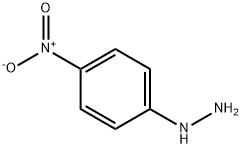
4-Nitrophenylhydrazine

4-Nitrophenylhydrazine
  • CAS No.:100-16-3

Important Notice

  1. This product is a chemical product/pharmaceutical intermediate. It is not a drug, an active pharmaceutical ingredient (API), or a pharmaceutical-grade material. It has not been granted a drug approval number or a Chemical Drug Substance Approval Notice, has not passed drug-related review and approval, and is not manufactured, tested, or released in accordance with pharmaceutical GMP.
  2. This product is intended solely for non-clinical research, process development, quality studies, further chemical processing, or chemical synthesis. It must not be used in drug-product manufacturing, clinical trials, clinical diagnosis, or administration to humans or animals, or be sold, used as an input, submitted for regulatory filing, or released as an API or pharmaceutical material.
  3. The purchaser must not use this product, or supply it to another party, for personal consumption, sports or fitness, weight loss, health supplements, food, or animal feed.
Other grades of this product :
4-Nitrophenylhydrazine Basic information
Product Name:4-Nitrophenylhydrazine
Synonyms:1-(4-NITROPHENYL)HYDRAZINE;(4-nitrophenyl)-hydrazin;(p-nitrophenyl)-hydrazin;Hydrazine, (4-nitrophenyl)-;Hydrazine, (p-nitrophenyl)-;Hydrazine,(4-nitrophenyl)-;p-Hydrazinonitrobenzene;p-Nitrophenylhydrazide
CAS:100-16-3
MF:C6H7N3O2
MW:153.14
EINECS:202-824-8
Product Categories:Phenylhydrazine;HydrazinesDerivatization Reagents;Derivatization Reagents HPLC;Nitrogen Compounds;Organic Building Blocks;UV-VIS;Aromatic Hydrazides, Hydrazines, Hydrazones and Oximes
Mol File:100-16-3.mol
4-Nitrophenylhydrazine Chemical Properties
Melting point 156 °C (dec.)(lit.)
Boiling point 276.04°C (rough estimate)
density 1.00
refractive index 1.6910 (estimate)
storage temp. Explosives area
pka3.81±0.20(Predicted)
color Orange-red leaflets or needles
Water Solubility soluble in hot water
Merck 14,6624
BRN 608107
CAS DataBase Reference100-16-3(CAS DataBase Reference)
NIST Chemistry ReferenceP-nitrophenyl hydrazine(100-16-3)
EPA Substance Registry SystemHydrazine, (4-nitrophenyl)- (100-16-3)
Safety Information
Hazard Codes F,Xn
Risk Statements 5-11-22-36/37/38-43-21/22
Safety Statements 16-26-36/37/39-37/39-36
RIDADR UN 3376 4.1/PG 1
WGK Germany 3
RTECS MV8225000
F 4.6
Hazard Note Flammable/Harmful
HazardClass 4.1
PackingGroup I
HS Code 29280000
Toxicitymmo-sat 2 mmol/L AEMIDF 44,801,82
MSDS Information
ProviderLanguage
4-Nitrophenylhydrazine English
SigmaAldrich English
ACROS English
ALFA English
4-Nitrophenylhydrazine Usage And Synthesis
Chemical Propertieswhite to light yellow crystal powde
UsesAnalytical reagent (aldehydes, ketones).
Uses4-Nitrophenylhydrazine is a nitro substituted aryl hydrazine with potential anticancer activity. Irritant.
DefinitionChEBI: A member of the class of phenylhydrazines that is phenylhydrazine substituted at the 4-position by a nitro group.
General Description4-Nitrophenylhydrazine is a orange-red leaflet or needles wetted with water. 4-Nitrophenylhydrazine will emit toxic oxides of nitrogen when heated to decomposition. 4-Nitrophenylhydrazine is slightly heavier than water and insoluble in water. 4-Nitrophenylhydrazine may be irritating to skin, eyes and mucous membranes. 4-Nitrophenylhydrazine may be toxic by ingestion. 4-Nitrophenylhydrazine may be explosive and sensitive to friction in the dry state. 4-Nitrophenylhydrazine is used as a reagent for ketones and aliphatic aldehydes.
Reactivity Profile4-NITROPHENYLHYDRAZINE is a powerful explosive. 4-Nitrophenylhydrazine can SELF-IGNITE in the presence of contaminants. Auto-ignition temperature may vary for 4-nitrophenylhydrazine similar to that of hydrazine which has an autoignition of as low as 74oC in contact with iron rust. Dangerous fire hazard or severe explosion can occur when exposed to heat, flame or oxidizing agents. Severe explosion may also occur by chemical reaction with alkali metals; BaO; CaO; K; Na; NH3; Cl2; chromates; CuO; Cu++ salts; F2; H2O2; iron rust; metallic oxides; PbO2;Ni; Ni(ClO4)2; HNO3; N2O; O2; liquid O2; K2Cr2O7; Na2Cr2O7; tetryl; zinc diamide; Zn(C2H5)2. Dangerous; when heated to decomposition 4-Nitrophenylhydrazine emits highly toxic nitrogen compounds; may explode by heat or chemical reaction. (Sax and Lewis, 1987) under Hydrazine p. 538-539.
Health HazardSome are toxic and may be fatal if inhaled, swallowed or absorbed through skin. Contact may cause burns to skin and eyes. Fire may produce irritating, corrosive and/or toxic gases. Runoff from fire control or dilution water may cause pollution.
Safety ProfilePoison by intraperitoneal route.Mutation data reported. When heated to decomposition itemits toxic fumes of NOx. See also NITROCOMPOUNDS OF AROMATIC HYDROCARBONS
Purification MethodsCrystallise the hydrazine from EtOH. The hydrochloride has m 212o(dec) (from EtOH, also m 202-203o dec). [Beilstein 15 III 331, 15 IV 317.]

Welcome!

Please leave a message for us or use the following ways to contact us, we will reply to you as soon as possible, and provide you with the most sincere service, thank you.

  • NO. 18 ,Wujiang Road, Wulidian Street, Jiangbei District, Chongqing
  • +86-23-6139-8061 +86-13650506873
  • danny@chemdad.com sales@chemdad.com
  • www.chemdad.com
  • WhatsApp +86-13650506873

Name

phone

company

email

message

Read the full Disclaimer
Payment methods
Google translate: 日本语日本语 한국어한국어 FrançaisFrançais DeutschDeutsch EspañaEspaña TürkiyeTürkiye