Other grades of this product :
| Fenarimol Basic information |
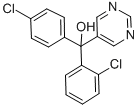
| Product Name: | Fenarimol | | Synonyms: | (2-Chlorophenyl)(4-chlorophenyl)5-pyrimidinylmethanol;(2-Chlorophenyl)-alpha-(4-chlorophenyl)-5-pyrimidinemethanol;.alpha.-(2-chlorophenyl)-.alpha.-(4-chlorophenyl)-5-Pyrimidinemethanol;2,4’-dichloro-alpha-(pyrimidin-5-yl)benzhydrylalcohol;5-Pyrimidinemethanol, alpha-(2-chlorophenyl)-alpha-(4-chlorophenyl)-;2,4-Dichloro-α-(pyrimidin-5-y1)diphenylmethanol;2,4'-DICHLORO-A-(PYRIMIDIN-5-YL)DIPHENYLMETHANOL;2,4'-dichloro-alpha-(5-pyrimidinyl)benzhydryl alcohol | | CAS: | 60168-88-9 | | MF: | C17H12Cl2N2O | | MW: | 331.2 | | EINECS: | 262-095-7 | | Product Categories: | FA - FLPesticides;Alpha sort;E-GAlphabetic;F;Fungicides;Pesticides&Metabolites;Pyrimidines;Alphabetic | | Mol File: | 60168-88-9.mol |
| Fenarimol Chemical Properties |
| Hazard Codes | Xn;N,N,Xn | | Risk Statements | 51/53-62-63-64 | | Safety Statements | 36/37-61 | | RIDADR | UN 3017/3077 | | WGK Germany | 2 | | RTECS | UV9279400 | | Toxicity | LD50 in mice, rats (mg/kg): 4500, 2500 orally (Beraud) |
| Fenarimol Usage And Synthesis |
| Uses | Plant fungicide. | | Uses | Fenarimol is a broad spectrum pyrimidine carbinol fungicide with
protective, curative and eradicative activities against powdery mildew
(Erysiphe spp., Pudusphaera leucutricha, Uncinula necatur, Sphaerutheca spp.,
Leveillula spp.) and scab (Venturia spp.) in many crops. It also controls
powdery mildew (Sphaerutheca pannusa) in ornamentals and Fusarium
patch (Micruduccium niuale), Take-all patch (Laefisaria fuciformis), Dollar
spot (Sderutina humeucavpa) and red thread (Gaeumannumyces graminis) in
turf and amenity grasses. | | Uses | Fenarimol is a pyrimidine based fungicide which acts against rusts, blackspot and mildew fungi and it works by inhibiting the fungus’s biosynthesis of important steroid molecules. | | General Description | Pure white crystalline solid. Used as a fungicide. Irritates skin and mucous membranes. | | Reactivity Profile | Fenarimol produces toxic gases when heated to decomposition. | | Safety Profile | Moderately toxic by
ingestion. Experimental reproductive
effects. Mutation data reported. When
heated to decomposition it emits toxic
fumes of Cland NOx. | | Metabolic pathway | The primary dissipation mechanism of fenarimol in the environment
involves photolysis on plants/soil surfaces and water. More than 80
photoproducts have been observed, resulting from the reduction of the
pyrimidine ring, hydrolysis, ring migration and cleavage of the phenyl
and pyrimidine ring moieties. Under laboratory conditions in the dark,
fenarimol is relatively persistent in soil, but a more rapid dissipation was
observed under field conditions with DT50 values of 18-140 days, attributed
to photolysis of fenarimol on the soil surface. Fenarimol degrades
in/on plant foliage/fruit surfaces mainly by photochemical processes.
In animals, fenarimol is metabolised extensively to yield hydroxylated,
cleavage and dechlorination products. The primary photolytic and
metabolic pathways of fenarimol are presented in Schemes 1 and 2. | | Degradation | Fenarimol(1) is stable in sterile buffered water in the dark at pH 3,6 and 9
at 25 °C, 37 °C and 52 °C for 28 days (Decker and Sullivan, 1975) but is
readily degraded via photolysis. The photolytic DT50 in distilled water
under natural sunlight and clear sky conditions at 40°N in mid-summer
was approximately 12 hours (Day, 1975). The primary aqueous photolysis
reaction involved the migration of the pyrimidine ring to one of
the chlorophenyl rings, followed by the oxidation of the carbinol moiety
to the corresponding ketone to yield 4-chloro-2-(5-pyrimidyl)-2'-chlorobenzophenone
(2).
Fenarimol was extensively photodegraded on solid surfaces. More than
80 photodegradation products were formed when fenarimol was exposed
to sunlight on a stainless steel surface for up to 200 hours (Althaus and
Bewley, 1978a). All photoproducts were formed at very low levels (less
than 3% each) and 14 were identified. An abbreviated photogradation
pathway of fenarimol is presented in Scheme 1. These products were
generated from the following reactions: the migration of the pyrimidine
ring to one of the chlorophenyl rings, followed by the oxidation of the
carbinol moiety to yield compound 2; cleavage of either one of the
chlorophenyl (to yield 3,4) or pyrimidine rings (5,6); aryl hydroxylation
of one of the chlorophenyl rings (7); carbinol dehydroxylation reaction
to yield 8 and a bridged fluorene product (9) from the dechlorination
reaction. Various cleavage products (carboxylic acids) derived from the
chlorophenyl (10-13) and the pyrimidine moieties (14) were also
observed. |
| Fenarimol Preparation Products And Raw materials |
|


 日本语
日本语 한국어
한국어 Français
 Deutsch
 España
 Türkiye