Other grades of this product :
| 4-Bromochlorobenzene Basic information |
| 4-Bromochlorobenzene Chemical Properties |
| 4-Bromochlorobenzene Usage And Synthesis |
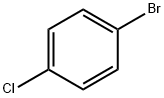
| Chemical Properties | white to almost white crystalline powder | | Uses | 1-Bromo-4-chlorobenzene is used as a pharmaceutical intermediate. | | Application | 1-Bromo-4-chlorobenzene is a cyclohexane derivative that has inhibitory properties. It reacts with 4-tert-butylbenzoic acid, hydrochloric acid and metathesis reactions with halides to form 1,2,3-triazoles. It is a molecule that emits light when heated to 300 °C in vitro. The carbonyl group on the ring of this molecule is responsible for the light emission when heated at high temperatures. It has been used as an analytical method for determining the concentration of nitrite ion in solution by measuring its light emission. | | Synthesis Reference(s) | Journal of the American Chemical Society, 86, p. 964, 1964 DOI: 10.1021/ja01059a073The Journal of Organic Chemistry, 55, p. 3415, 1990 DOI: 10.1021/jo00297a087 |
| 4-Bromochlorobenzene Preparation Products And Raw materials |
| Preparation Products | 4-(4-CHLOROBENZOYL)PYRIDINE-->4-Chloro-N-methylaniline-->4-Bromophenoxybenzene-->4-Chloro-alpha-methylstyrene-->N,N-Diethyl-1,4-phenylenediamine-->4,4'-DDM-->Propiolic acid, (p-chlorophenyl)- (8CI)-->4-(4-CHLOROBENZYL)PYRIDINE-->4,4'-DICHLORO-ALPHA-METHYLBENZHYDROL-->4-Chlorodiphenyl ether-->5-BROMO-2-CHLORO-BENZOYL CHLORIDE-->9-[4'-(4,4,5,5-TETRAMETHYL-1,3,2-DIOXABOROLAN-2-YL)[1,1'-BIPHENYL]-3-YL]-9H-CARBAZOLE-->5-(4-CHLOROPHENYL)-2-FURALDEHYDE |
|


 日本语
日本语 한국어
한국어 Français
 Deutsch
 España
 Türkiye