Other grades of this product :
| 4-BUTYROTHIOLACTONE Basic information |
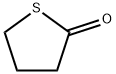
| Product Name: | 4-BUTYROTHIOLACTONE | | Synonyms: | 2(3H)-dihydrothiophenone;Dihydrothiophen-2(3H)-one;Tetrahydrothiophene-2-one;tetrahydrothiophen-2-one;γ-Thiobutyrolactone,4-Butyrothiolactone;2(3H)-Thiophenone, dihydro-;2-Oxothiolane;2-Thiophenone, tetrahydro- | | CAS: | 1003-10-7 | | MF: | C4H6OS | | MW: | 102.15 | | EINECS: | 213-700-8 | | Product Categories: | Heterocyclic Compounds | | Mol File: | 1003-10-7.mol |
| 4-BUTYROTHIOLACTONE Chemical Properties |
| Hazard Codes | Xn | | Risk Statements | 22 | | Safety Statements | 36 | | RIDADR | UN 3334 | | WGK Germany | 3 | | RTECS | XN1930000 |
| 4-BUTYROTHIOLACTONE Usage And Synthesis |
| Uses | γ-Thiobutyrolactone was used to terminate the ring opening polymerization of ω-pentadecalactone to synthesize difunctional polyesters. γ-Thiobutyrolactone was used to study the mechanism of metabolism of sulphur containing heterocyclic compounds by lignin-degrading basidiomycete Coriolus versicolor. | | General Description | γ-Thiobutyrolactone undergoes copolymerization with glycidyl phenyl ether to form poly(ester-alt-sulfide). |
| 4-BUTYROTHIOLACTONE Preparation Products And Raw materials |
|


 日本语
日本语 한국어
한국어 Français
 Deutsch
 España
 Türkiye