Other grades of this product :
| ML-7 HYDROCHLORIDE Basic information |
| ML-7 HYDROCHLORIDE Chemical Properties |
| Melting point | 246-249°C dec. | | storage temp. | -20°C | | solubility | insoluble in EtOH; ≥15.95 mg/mL in DMSO; ≥8.82 mg/mL in H2O with gentle warming and ultrasonic | | form | powder | | color | white |
| ML-7 HYDROCHLORIDE Usage And Synthesis |
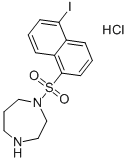
| Description | ML-7 inhibits smooth muscle myosin light chain kinase (MLCK) with a Ki value of 0.3 μM and displays reversible, ATP-competitive inhibition of Ca2+-calmodulin-dependent and -independent smooth muscle MLCKs. It exhibits a 10-fold more potent inhibition of MLCK than its parent compound ML-9 . | | Chemical Properties | Off-White to Yellow Fine Crystalline Solid | | Uses | A potent and selective inhibitor of myosin light chain kinase. | | Uses | ML-7 has been used as a myosin light chain kinase (MLCK) inhibitor in various experiments. | | Biochem/physiol Actions | Selective myosin light chain kinase inhibitor. | | in vitro | rats with myocardial infarction were intravenously infused with rhnrg-1. the cmlck expression and phosphorylated mlc-2v were up-regulated in rat treated with rhnrg-1 significantly. moreover, the restoration of rhnrg-1-induced sarcomeric organization in serum-free cultured neonatal rat cardiomyocytes with rhnrg-1 was inhibited by ml-7 [1]. | | in vivo | administration of ml-7 from 10 min before ischemia to the first 10 min of reperfusion led to a significant recovery of heart contractility. gel analyses of two-dimensional electrophoresis revealed eight proteins with decreased levels in i/r hearts. six proteins involved in energy metabolism, which were cytochrome b-c1 complex subunit 1, atp synthase beta subunit, cytochrome c oxidase subunit, mitochondrial nadhdehydrogenase, nadhdehydrogenase iron-sulfur protein 8, and succinyl-coa ligase subunit. the other two protein levels decreased in i/r hearts, which were peroxiredoxin-2 and tubulin. in addition, ml-7 treatment increased the level of succinyl-coa ligase, which was a key enzyme involved in the citric acid cycle [2]. | | references | [1] gu x,liu x,xu d,li x,yan m,qi y,yan w,wang w,pan j,xu y,xi b,cheng l,jia j,wang k,ge j,zhou m. cardiac functional improvement in rats with myocardial infarction by up-regulating cardiac myosin light chain kinase with neuregulin. cardiovasc res.2010 nov 1;88(2):334-43. [2] lin hb,cadete vj,sawicka j,wozniak m,sawicki g. effect of the myosin light chain kinase inhibitor ml-7 on the proteome of hearts subjected to ischemia-reperfusion injury. j proteomics.2012 sep 18;75(17):5386-95. |
| ML-7 HYDROCHLORIDE Preparation Products And Raw materials |
|


 日本语
日本语 한국어
한국어 Français
 Deutsch
 España
 Türkiye