Other grades of this product :
| Caprylic acid methyl ester Basic information |
| Caprylic acid methyl ester Chemical Properties |
| Caprylic acid methyl ester Usage And Synthesis |
| Description | Methyl octanoate has a powerful, winey, fruity, and orange-like
odor with an oily, somewhat orange taste. Prepared from coconut
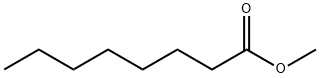
fatty acids by alcoholysis in the presence of gaseous HCL. | | Description | Octanoic acid methyl ester is a fatty acid methyl ester that has been found in biodiesels made from the transesterification of beef tallow, soybean oil, and babassu oil blends. It is an aromatic volatile compound in cantaloupe, galia, and honeydew melons. | | Chemical Properties | clear colorless liquid | | Chemical Properties | Methyl octanoate has a powerful, winy, fruity and orange-like odor and an oily, somewhat orange taste. | | Occurrence | Reported found in apples, apricot, orange juice, coconut, pineapple, pear, strawberry, citrus peel oils, grapes,
papaya, blackberry, kohlrabi, peas, potato, tomato, clove bud, pepper, many cheeses, butter, hop oil, cognac, rum, cider, grape wines,
black tea, durian (Durio zibethinus), olive, passion fruit, plum, plumcot, mushrooms, starfruit, fruit brandies, quince, soursop, wort,
cherimoya, kiwifruit, mountain papaya, custard apple, nectarine, naranjilla, lamb’s lettuce, mussels, cape gooseberry, spineless monkey orange, pawpaw and rooibus tea (Aspalathus linearis) | | Uses | Methyl octanoate can be used as: - A reactant to prepare C7 and C8 hydrocarbons by catalytic decarboxylation/decarbonylation reactions in the presence of Pt/Al2O3 catalyst.
- A component of biodiesel ?bioethanol surrogate fuel model to study its kinetics of oxidation.
| | Uses | Intermediate for caprylic acid detergents, emulsifiers, wetting agents, stabilizers, resins, lubricants,
plasticizers, flavoring. | | Uses | Methyl octanoate-ethanol mixtures constitute the biodiesel-bioethanol surrogate fuel and kinetics of its oxidation has been studied experimentally in a jet-stirred reactor. Deoxygenation of methyl octanoate over alumina-supported Pt has been studied in both the vapor phase in a flow reactor and in the liquid phase in a semi-batch reactor. It is also used to make other chemicals. | | Preparation | From coconut fatty acids by alcoholysis in the presence of gaseous HCl | | Definition | ChEBI: A fatty acid methyl ester resulting from the formal condensation of the carboxy group of octanoic acid with the hydroxy group of methanol. | | Aroma threshold values | Detection: 200 to 870 ppb | | Taste threshold values | Detection: 200 to 870 ppb | | Synthesis Reference(s) | The Journal of Organic Chemistry, 50, p. 560, 1985 DOI: 10.1021/jo00205a004Tetrahedron, 36, p. 1311, 1980 DOI: 10.1016/0040-4020(80)85042-3Tetrahedron Letters, 25, p. 4417, 1984 DOI: 10.1016/S0040-4039(01)81454-4 | | General Description | A colorless liquid. Flash point 130°F. Insoluble in water and about the same density as water. Used to make other chemicals. | | Air & Water Reactions | Insoluble in water. | | Reactivity Profile | Caprylic acid methyl ester is an ester. Esters react with acids to liberate heat along with alcohols and acids. Strong oxidizing acids may cause a vigorous reaction that is sufficiently exothermic to ignite the reaction products. Heat is also generated by the interaction of esters with caustic solutions. Flammable hydrogen is generated by mixing esters with alkali metals and hydrides. | | Health Hazard | Inhalation or contact with material may irritate or burn skin and eyes. Fire may produce irritating, corrosive and/or toxic gases. Vapors may cause dizziness or suffocation. Runoff from fire control or dilution water may cause pollution. | | Flammability and Explosibility | Nonflammable | | Purification Methods | Pass the ester through alumina and distil it before use. [Beilstein 2 IV 986.] |
| Caprylic acid methyl ester Preparation Products And Raw materials |
|


 日本语
日本语 한국어
한국어 Français
 Deutsch
 España
 Türkiye