Other grades of this product :
| 2-AAPA Chemical Properties |
| storage temp. | -20°C | | solubility | Soluble in DMSO (50 mg/ml) | | form | solid | | color | White to off-white | | Stability: | Stable for 2 years from date of purchase as supplied. Solutions in DMSO may be stored at -20°C for up to 1 month1. |
| 2-AAPA Usage And Synthesis |
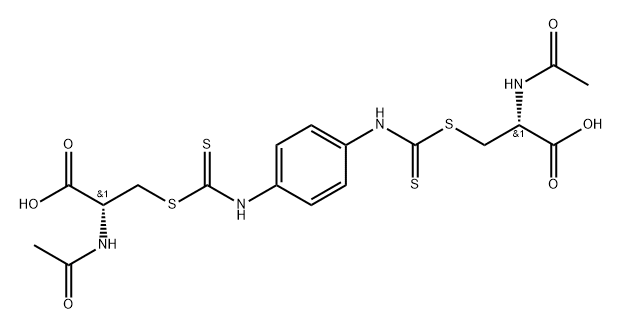
| Description | 2-AAPA (1133387-90-2) inhibits glutathione reductase and thioredoxin reductase,IC50s=6.7 and 8.7 μM respectively, and impairs mitochondrial function.1 May be used to induce a cellular model of thiol oxidative stress.2? Enhances sensitivity of cancer cell lines to X-ray irradiation.3 Induces G2/M cell cycle arrest by inducing thiol oxidative stress resulting in a-tubulin S-glutathionylation-mediated microtubule depolymerization.4 Improves limb revascularization by glutathionylation and subsequent stabilization of HIF-1a.5 | | References | de Souza et al. (2017), Inhibition of reductase systems by 2-AAPA modulates peroxiredoxin oxidation and mitochondrial function in A172 glioblastoma cells; Toxicol. In Vitro, 42 273
Xie et al. (2014), Evaluation of a dithiocarbamate derivative as a model of thiol oxidative stress in H9c2 rat cardiomyocytes; Free Radic. Biol. Med. 70 214
Zhao et al. (2009), Increase in thiol oxidative stress by glutathione reductase inhibition as a novel approach to enhance cancer sensitivity to X-ray irradiation; Free Radic. Biol. Med., 47 176
Li et al. (2017), 2-acetylamino-3-[4-(2-acetylamino-2-carboxyethylsulfanylcarbonylamino)phenylcarbamoylsulfanyl] propionic acid, a glutathione reductase inhibitor, induces G2/M cell cycles arrest through generation of thiol oxidative stress in human esophageal cancer cells; Oncotarget, 8 61846
Watanabe et al. (2016), Glutathione adducts induced by ischemia and deletion of glutatedoxin-1 stabilize HIF-1α and improve limb revascularization; Proc. Natl. Acad. Sci. USA, 113 6011 |
| 2-AAPA Preparation Products And Raw materials |
|


 日本语
日本语 한국어
한국어 Français
 Deutsch
 España
 Türkiye