Other grades of this product :
| 2,2,6,6-TETRAMETHYL-3,5-HEPTANEDIONE Basic information |
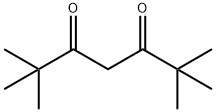
| Product Name: | 2,2,6,6-TETRAMETHYL-3,5-HEPTANEDIONE | | Synonyms: | (CH3)3CCOCH2COC(CH3)3;2,2,6,6-Tetramethyl heptanedione;2,2,6,6-tetramethyl-5-heptanedione;TMHD;DIPIVALOYLMETHANE;2,2,6,6-TETRAMETHYL-3,5-HEPTANEDIONE DIPIVALOYLMETHANE;2,2,6,6-TETRAMETHYL-3,5-HEPTANEDIONE;2,2,6,6-TETRAMETHYLHEPTANE-3,5-DIONE | | CAS: | 1118-71-4 | | MF: | C11H20O2 | | MW: | 184.28 | | EINECS: | 214-268-3 | | Product Categories: | Achiral Oxygen;organic compound;Environmentally-friendly Oxidation;Ligands (Environmentally-friendly Oxidation);Synthetic Organic Chemistry;CHIRAL CHEMICALS | | Mol File: | 1118-71-4.mol |
| 2,2,6,6-TETRAMETHYL-3,5-HEPTANEDIONE Chemical Properties |
| Melting point | >400 °C (decomp) | | Boiling point | 72-73 °C/6 mmHg (lit.) | | density | 0.883 g/mL at 25 °C (lit.) | | refractive index | n20/D 1.459(lit.) | | Fp | 153 °F | | storage temp. | Sealed in dry,Room Temperature | | solubility | Difficult to mix. | | form | Liquid | | pka | 11.60±0.10(Predicted) | | Specific Gravity | 0.883 | | color | Clear colorless to slightly yellow | | BRN | 1447269 | | InChIKey | YRAJNWYBUCUFBD-UHFFFAOYSA-N | | CAS DataBase Reference | 1118-71-4(CAS DataBase Reference) | | EPA Substance Registry System | 3,5-Heptanedione, 2,2,6,6-tetramethyl- (1118-71-4) |
| 2,2,6,6-TETRAMETHYL-3,5-HEPTANEDIONE Usage And Synthesis |
| Chemical Properties | CLEAR COLOURLESS TO SLIGHTLY YELLOW LIQUID | | Uses | suzuki reaction | | Uses | 2,2,6,6-tetramethyl-3,5-heptanedione was used in the synthesis of α-aryl-β-diketones1 and dicyanamidobenzene-bridge diruthenium complex. | | Uses | 2,2,6,6-Tetramethyl-3,5-heptanedione is a beta diketone with antibacterial activity. | | Synthesis Reference(s) | Journal of the American Chemical Society, 100, p. 5428, 1978 DOI: 10.1021/ja00485a030 | | General Description | Acylation, a replacement to silylation, allows the conversion of compounds that consist of active hydrogens (-OH, -SH and -NH) into esters, thioesters, and amides via the action of a carboxylic acid or derivative. The carbonyl group adjacent to the halogenated carbons is known to improve the electron capture detector (ECD) response. Acylation has several advantages:- It enhances the stability of compounds by protecting unstable groups.
- It may confer volatility on substances like carbohydrates or amino acids, that have several polar groups that they are non-volatile and usually decompose on heating.
- It facilitates the separations not possible with underivatized compounds.
- Compounds are detectable at very low levels with an ECD.
2,2,6,6-Tetramethyl-3,5-heptanedione is a reagent used to form fragmentation-directing derivatives for GC/MS analysis. |
| 2,2,6,6-TETRAMETHYL-3,5-HEPTANEDIONE Preparation Products And Raw materials |
| Raw materials | Ethanol-->Hydrochloric acid-->Ethyl acetate-->Diethyl ether-->Tetrahydrofuran-->N,N-Dimethylformamide-->Sodium hydride-->Pinacolone-->Methyl trimethylacetate-->4-Heptyn-3-one, 2,2,6,6-tetramethyl--->Benzenemethanamine, N-(1,2,2-trimethylpropylidene)--->Dipivaloylamine-->2,2-Dimethylpropanoic acid phenyl ester-->Propanamide,2,2-dimethyl-N-(phenylmethyl)--->2,3,3-TRIMETHYL-2-BUTANOL-->8-Hydroxyquinoline | | Preparation Products | N,N-DIPHENYLQUINACRIDONE |
|


 日本语
日本语 한국어
한국어 Français
 Deutsch
 España
 Türkiye