| Chemical Properties | brown to black crystalline chunks |
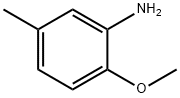
| Chemical Properties | p-Cresidine is a white crystalline solid. |
| Uses | p-Cresidine is a reagent used in the preparation of enaminones acting as anticonvulsants. Also used in the preparation of crescent oligoamides. Dyes and metabolites, Environmental Testing. |
| Uses | 2-Methoxy-5-methylaniline was used in the synthesis of 4-(4-Amino-5-methoxy-2-methylphenylazo)-5-hydroxy-naphthalene-2,7-disulfonic acid. 2-Methoxy-5-methylaniline was used to analyse the application of polymeric ionic liquids as selective solid-phase microextraction sorbent coatings for the analysis of genotoxic impurities and structurally alerting compounds such as alkyl halides and aromatics. 2-Methoxy-5-methylaniline was used in a study to develop a sensitive analytical method for the determination of aromatic amines found in commercial hair dyes using high liquid chromatography coupled to an electrochemical detector by using the ionic liquid 1-butyl-3-methylimidazolium bis(trifluoromethanesulfonyl)imide in the mobile phase. |
| Uses | p-Cresidine is a reagent used in the preparation of enaminones acting as anticonvulsants. Also used in the preparation of crescent oligoamides. |
| General Description | White to silver-gray odorless crystals. |
| Air & Water Reactions | Insoluble in water. |
| Reactivity Profile | 2-Methoxy-5-methylaniline is sensitive to moisture and temperatures greater than 104°F. Incompatible with strong oxidizing agents . |
| Hazard | A possible carcinogen. |
| Fire Hazard | 2-Methoxy-5-methylaniline is nonflammable. |
| Safety Profile | Confirmed carcinogen
with experimental carcinogenic and
neoplastigenic data. Moderately toxic by
ingestion. A skin and eye irritant. Mutation
data reported. When heated to
decomposition it emits toxic fumes of NOx.
See also ESTERS. |
| Potential Exposure | p-Cresidine is used as an intermediate in the production of various azodyes, printing inks, and pigments; including 11 dyes that are produced commercially in the United States. Human exposure to p-Cresidine occurs primarily through inhalation of |
| Carcinogenicity | p-Cresidine is reasonably anticipated to be a human carcinogen based on sufficient evidence of carcinogenicity from studies in experimental animals. |
| Shipping | UN2811 Toxic solids, organic, n.o.s., Hazard Class: 6.1; Labels: 6.1-Poisonous materials, Technical Name Required |
| Incompatibilities | Incompatible with oxidizers (chlorates, nitrates, peroxides, permanganates, perchlorates, chlorine, bromine, fluorine, etc.); contact may cause fires or explosions. Keep away from alkaline materials, strong bases, strong acids, oxoacids, epoxides. |


 日本语
日本语 한국어
한국어 Français
 Deutsch
 España
 Türkiye