Other grades of this product :
| ANISYL FORMATE Basic information |
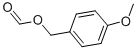
| Product Name: | ANISYL FORMATE | | Synonyms: | 4-methoxy-benzenemethanoformate;anisyl;Benzenemethanol,4-methoxy-,formate;FEMA 2101;ANISYL FORMATE;4-METHOXYBENZYL FORMATE;ANISYL FORMATE 90+% FCC;Formic acid 4-methoxybenzyl ester | | CAS: | 122-91-8 | | MF: | C9H10O3 | | MW: | 166.17 | | EINECS: | 204-582-9 | | Product Categories: | | Mol File: | 122-91-8.mol |
| ANISYL FORMATE Chemical Properties |
| Hazard Codes | Xn | | Risk Statements | 20/21/22-36/37/38 | | Safety Statements | 26 | | WGK Germany | 3 | | toxicity | The acute oral LD50 value in rats was reported as 1.55 ml/kg and the acute dermal LD50 value in rabbits exceeded 5 g/kg(Levenstein, 1975). |
| ANISYL FORMATE Usage And Synthesis |
| Chemical Properties | Colorless liquid; lilac odor. Soluble in 5.5 volumes of 70% alcohol. Combustible. | | Chemical Properties | Anisyl formate has a floral, sweet, floral, herbaceous-green odor. | | Occurrence | Reported found in Vanilla fragrans and Ribes species. | | Uses | Perfumery, flavoring. | | Uses | Anisyl formate is a synthetic flavoring agent that is a fairly stable, colorless to light yellow liquid of floral odor. It should be stored in glass, tin, or resin-lined containers. It is used in berry flavors for applications in beverages, candy, and baked goods at 3–10 ppm.
| | Preparation | By direct esterification of anisic alcohol with formic acid. | | Aroma threshold values | Odor characteristics are sweet, spicy, vanilla-like with powdery fruity nuances. | | Taste threshold values | Taste characteristics at 50 ppm: sweet, vanilla, spice, with fruity heliotropine-like nuances. | | Flammability and Explosibility | Notclassified | | Metabolism | Esters of benzyl alcohol, such as the acetate, are rapidly hydrolysed in vivo to benzyl alcohol, which is then oxidized. The expected general reaction of primary aromatic alcohols in the animal body is oxidation to the corresponding aromatic acid, which is usually excreted as a glycine conjugate and to a lesser extent as an ester glucuronide. In rabbits, benzyl alcohol is almost entirely converted to benzoic acid, which is excreted mainly as hippuric acid . In substituted anisoles with a carboxyl group or a potential carboxyl group attached to the aromatic ring, the ether link is relatively stable(Williams, 1959). |
| ANISYL FORMATE Preparation Products And Raw materials |
|


 日本语
日本语 한국어
한국어 Français
 Deutsch
 España
 Türkiye