Other grades of this product :
| 2-Methyl-3-buten-2-ol Basic information |
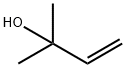
| Product Name: | 2-Methyl-3-buten-2-ol | | Synonyms: | 1,1-DIMETHYLALLYL ALCOHOL;2-METHYL-3-BUTENE-2-OL;2-HYDROXY-2-METHYL-3-BUTENE;1,1-Dimethylallyl alcohol, 3-Hydroxy-3-methyl-1-butene;2-Methyl-3-buten-2-ol,97%;2-Methyl-3-buten-2-ol, 97% 250ML;Methyl-3-bute;1,1-Dimethylallyl alcohol
3-Hydroxy-3-methyl-1-butene
2-Hydroxy-2-methyl-3-butene | | CAS: | 115-18-4 | | MF: | C5H10O | | MW: | 86.13 | | EINECS: | 204-068-4 | | Product Categories: | | Mol File: | 115-18-4.mol |
| 2-Methyl-3-buten-2-ol Chemical Properties |
| Melting point | -43 °C | | Boiling point | 98-99 °C (lit.) | | density | 0.824 g/mL at 25 °C (lit.) | | vapor pressure | 51 mm Hg ( 25 °C) | | refractive index | n20/D 1.416(lit.) | | Fp | 56 °F | | storage temp. | Store below +30°C. | | form | Liquid | | pka | 14.56±0.29(Predicted) | | color | Clear colorless to very slightly yellow | | PH | 9-10 (100g/l, H2O, 20℃) | | explosive limit | 1.5-9.4%(V) | | BRN | 1698263 | | LogP | 0.66 at 25℃ | | CAS DataBase Reference | 115-18-4(CAS DataBase Reference) | | NIST Chemistry Reference | 3-Buten-2-ol, 2-methyl-(115-18-4) | | EPA Substance Registry System | 2-Methyl-3-buten-2-ol (115-18-4) |
| Hazard Codes | F,Xn,F++ | | Risk Statements | 11-22-36 | | Safety Statements | 16-26-36 | | RIDADR | UN 1987 3/PG 2 | | WGK Germany | 1 | | RTECS | EM9472000 | | Autoignition Temperature | 380 °C | | TSCA | Yes | | HazardClass | 3 | | PackingGroup | II | | HS Code | 29052990 | | Toxicity | LD50 orally in Rabbit: 1800 mg/kg |
| 2-Methyl-3-buten-2-ol Usage And Synthesis |
| Chemical Properties | clear colourless to very slightly yellow liquid | | Uses | 2-Methyl-3-buten-2-ol was used to study the kinetics of the gas-phase reaction of OH radicals with 3-methyl-2-butenal. | | Uses | 2-Methyl-3-buten-2-ol may be used as an analytical reference standard for the determination of the analyte in Humulus Lupulus L. (Hop) and pine-mushroom extracts by chromatography techniques. | | General Description | Colorless liquid. | | Air & Water Reactions | Slightly soluble in water. | | Reactivity Profile | An unsaturated aliphatic/alcohol. The unsaturated aliphatic hydrocarbons are generally much more reactive than the alkanes, which are saturated aliphatic hydrocarbons. Strong oxidizers may react vigorously with them. Reducing agents can react exothermically to release gaseous hydrogen. Flammable and/or toxic gases are generated by the combination of alcohols with alkali metals, nitrides, and strong reducing agents. They react with oxoacids and carboxylic acids to form esters plus water. Oxidizing agents convert them to aldehydes or ketones. Alcohols exhibit both weak acid and weak base behavior. They may initiate the polymerization of isocyanates and epoxides. | | Health Hazard | Harmful if inhaled or swallowed. Material is irritating to mucous membrane and upper respiratory tract. | | Fire Hazard | Special Hazards of Combustion Products: Vapor may travel considerable distance to a source of ignition and flash back. |
| 2-Methyl-3-buten-2-ol Preparation Products And Raw materials |
|


 日本语
日本语 한국어
한국어 Français
 Deutsch
 España
 Türkiye