Other grades of this product :
| RADICICOL Basic information |
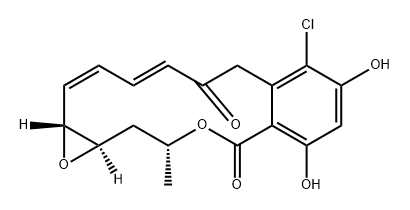
| Product Name: | RADICICOL | | Synonyms: | (1AR,2Z,4E,14R,15AR)-8-CHLORO-1A,14,15,15A-TETRAHYDRO-9,11-DIHYDROXY-14-METHYL-6H-OXIRENO[E][2]BENZOXACYCLOTETRADECIN-6,12(7H)-DIONE;[1AS-(1AR*,2Z,4E,14*,15AR*)]-8-CHLORO-1A,14,15,15A-TETRAHYDRO-9,11-DIHYDROXY-14-METHYL-6H-OXIRENO[E][2]BENZOXACYCLOTETRADECIN-6,12(7H)-DIONE;5-CHLORO-6-(7,8-EPOXY-10-HYDROXY-2-OXO-3,5-UNDECADIENYL)-BETA-RESORCYLIC ACID MU-LACTONE;FO-4910;KF58332;KF9-A;MONORDEN;MONORODENE | | CAS: | 12772-57-5 | | MF: | C18H17ClO6 | | MW: | 364.78 | | EINECS: | | Product Categories: | antibiotic;Heat Shock Protein 90 | | Mol File: | 12772-57-5.mol |
| RADICICOL Chemical Properties |
| Melting point | 193.5° | | alpha | D20 +203° (chloroform) | | Boiling point | 656.2±55.0 °C(Predicted) | | density | 1.364±0.06 g/cm3(Predicted) | | storage temp. | −20°C | | solubility | ethanol: 10 mg/mL | | form | solid | | pka | 6.29±0.40(Predicted) | | color | yellow | | Stability: | Stable for 2 years from date of purchase as supplied. Solutions in DMSO or ethanol may be stored at -20°C for up to 1 month. |
| RADICICOL Usage And Synthesis |
| Description | Radicicol (12772-57-5) inhibits heat shock protein 90 (HSP90) activity by binding to the ATP-binding pocket.1?In cells HSP90 client proteins such as Raf kinase2, HIF-1α3?and estrogen receptor4?are destabilized and proteolytically degraded. Radicicol inhibits expression of COX-2 without affecting COX-1 expression in LPS-stimulated macrophages (IC50=27 nM).5?Inhibits angiogenesis.6 | | Chemical Properties | Solid | | Uses | Radicicol is a resorcylic acid lactone, produced by several fungal species, that exhibits broad spectrum antifungal and antitumour activity. Radicicol has been the subject of extensive investigation and inhibits protein tyrosine kinase, induces the differentiation of HL-60 cells into macrophages, blocks cell cycle at G1 and G2, suppresses NIH 3T3 cell transformation by diverse oncogenes such as src, ras and mos, and also suppresses the expression of mitogen-inducible cyclooxygenase-2. As a cell differentiation modulator, radicicol has anti-angiogenic activity in vivo, inhibiting the proliferation of plasminogen activator production by vascular endothelial cells. | | Uses | Radicicol is an antitumor antibiotic, which inhibits the Hsp90 molecular chaperone. | | Uses | Radicicol from Diheterospora chlamydosporia has been used as an inhibitor of heat shock protein 90 (Hsp90):- to study its effects on lifespan extension and health in Caenorhabditis elegans
- to study its effects on protein aggregation in yeast
- to study its effects on xanthone sensitized cancer cells
| | Definition | ChEBI: An antifungal macrolactone antibiotic, obtained from Diheterospora chlamydosporia and Chaetomium chiversii that inhibits protein tyrosine kinase and heat shock protein 90 (Hsp90). | | Biological Activity | Antifungal antibiotic. Inhibits heat shock protein 90 (Hsp90) activity by binding to the ATP-binding pocket, subsequently suppressing cell transformation induced by src, ras and mos. Represses estrogen receptor transcriptional activity and inhibits angiogenesis. | | Biochem/physiol Actions | Radicicol is an antifungal macrolactone antibiotic that is found in Diheterospora chlamydosporia, Chaetomium chiversii, and Monosporium bonorden. It functions as an inhibitor of tyrosine kinase and heat shock protein 90 (Hsp90). Radicicol is involved in the suppression of transformation of various proto-oncogenes such as Ras, Mos, and Src. It also suppresses the activity of mitogen-induced cyclooxygenase-2 (COX-2) and phosphoinositide-dependent kinase 1 (PDK1). Radicicol is involved in arresting the cell cycle at the G1-S phase. It exhibits ant-cancer and anti-angiogenic activity in vivo. | | References | 1) Schulte?et al. (1999),?Interaction of radicicol with members of the heat shock protein 90 family of molecular chaperones; Mol. Endocrinol.,?13?1435
2) Soga?et al. (1998),?Radicicol leads to selective depletion of Raf kinase and disrupts K-Ras-activated aberrant signaling pathway; J. Biol. Chem.,?273?822
3) Hur?et al. (2002)?Reduction of hypoxia-induced transcription through the repression of hypoxia-inducible factor-1alpha/aryl hydrocarbon receptor nuclear translocator DNA binding by the 90-kDa heat-shock protein inhibitor radicicol; Mol. Pharmacol.,?62?975
4) Lee?et al.?(2002)?Radicicol represses the transcriptional function of the estrogen receptor by suppressing the stabilization of the receptor by heat shock protein 90; Mol. Cell. Endocrinol.,?188?47
5) Chanmugam et al. (1995)?Radicicol, a protein tyrosine kinase inhibitor, suppresses the expression of mitogen-inducible cyclooxygenase in macrophages stimulated with lipopolysaccharide and in experimental glomerulonephritis; J. Biol. Chem.,?270?5418
6) Oikawa?et al. (1993)?Radicicol, a microbial cell differentiation modulator, inhibits in vivo angiogenesis; Eur. J. Pharmacol.,?241?221 |
| RADICICOL Preparation Products And Raw materials |
|


 日本语
日本语 한국어
한국어 Français
 Deutsch
 España
 Türkiye