Other grades of this product :
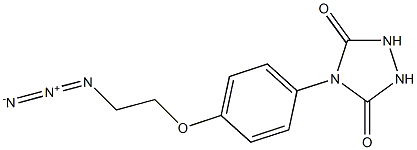
| 4-(4-(2-Azidoethoxy)phenyl)-1,2,4-triazolidine-3,5-dione Basic information |
| 4-(4-(2-Azidoethoxy)phenyl)-1,2,4-triazolidine-3,5-dione Chemical Properties |
| storage temp. | 2-8°C | | form | powder or crystals |
| 4-(4-(2-Azidoethoxy)phenyl)-1,2,4-triazolidine-3,5-dione Usage And Synthesis |
| Uses | PTAD-Azide is a selective crosslinking reagent that has one end for reacting with tyrosine and the other end for presenting an azide. After bioconjugation to tyrosine, the azide can be reacted with an alkyne through the Cu(I)-catalyzed click chemistry reaction or with a cyclooctyne in a copper-free reaction. This reagent has been shown to selectively introduce poly(ethylene glycol) or PEG chains onto proteins with surface exposed tyrosine residues. PTAD-Azide has also been used in the formation of antibody-drug conjugates. This reagent is compatible with different buffer systems such as PBS, Tris and mixed PBS/Tris buffer (preferred). The linkage with tyrosine has been shown to be stable to pH and temperature extremes as well as blood plasma. Note: PTAD-Azide must be first activated by stirring in a 1:0.98 molar ratio with 1,3-dibromo-5,5-dimethylhydantoin (product # 157902). Activation is evident upon solution color change from colorless to deep red and the activated reagent should be used immediately. General Procedure for Protein Modification with PTAD. Part 1: PTAD activation- Mix together 1:0.98 molar equivalents of unactivated PTAD to 1,3-dibromo-5,5-dimethylhydantoin (product # 157902) in organic solvent (preferred solvents are DMF or acetonitrile, avoid using DMSO)
- Color change is observed from colorless/pale yellow to deep red (approximately 5 min of mixing).
- After the solution turns red, store the now activated reagent on ice and use for protein modification within 30 min.
Part 2: Protein modification- Add protein solution in mixed phosphate/Tris buffer or Tris buffer (pH should be 6 - 9) to the eppendorf tube (or other vial) containing the activated PTAD reagent prepared above and mix gently at room temperature for up to 30 min. Preferably use 10-fold molar excess of reagent relative to protein. Use protein at a minimum concentration of 1 mg/ml (higher concentrations are preferred for enhanced labeling).
- Remove excess unreacted PTAD by gel filtration.
| | General Description | PTAD-Azide (4-(4-(2-Azidoethoxy)phenyl)-1,2,4-triazolidine-3,5-dione) is a 1,2,4-triazolidine-3,5-dione derivative. It can be prepared from ethyl hydrazinecarboxylate. |
| 4-(4-(2-Azidoethoxy)phenyl)-1,2,4-triazolidine-3,5-dione Preparation Products And Raw materials |
|


 日本语
日本语 한국어
한국어 Français
 Deutsch
 España
 Türkiye