Other grades of this product :
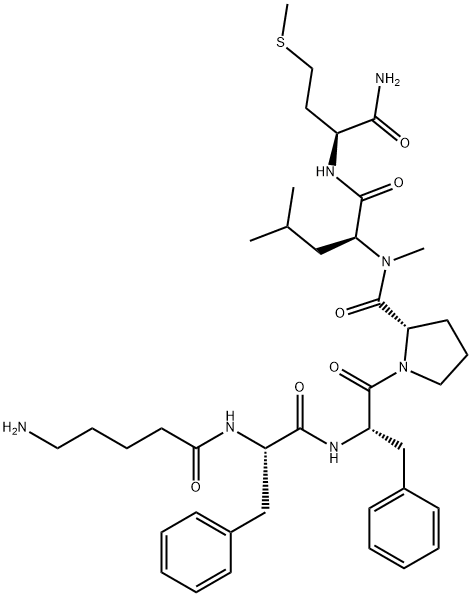
| DELTA-AMINOVALERYL-PHE-PHE-PRO-N-ME-LEU-MET-NH2 Basic information |
| Product Name: | DELTA-AMINOVALERYL-PHE-PHE-PRO-N-ME-LEU-MET-NH2 | | Synonyms: | δ-Aminovaleryl-[Pro9, Leu(N-Me)10]-SubstanceP Fragment 7-11;N-(5-Amino-1-oxopentyl)-L-Phe-L-Phe-L-Pro-N-methyl-L-Leu-L-Met-NH2;(2S)-1-[(2S)-2-[[(2S)-2-(5-aminopentanoylamino)-3-phenyl-propanoyl]amino]-3-phenyl-propanoyl]-N-[(1S)-1-[[(1S)-1-carbamoyl-3-(methylthio)propyl]carbamoyl]-3-methyl-butyl]-N-methyl-pyrrolidine-2-carboxamide;(2S)-N-[(2S)-1-[[(2S)-1-amino-4-methylsulfanyl-1-oxobutan-2-yl]amino]-4-methyl-1-oxopentan-2-yl]-1-[(2S)-2-[[(2S)-2-(5-aminopentanoylamino)-3-phenylpropanoyl]amino]-3-phenylpropanoyl]-N-methylpyrrolidine-2-carboxamide;(2S)-N-[(2S)-1-[[(2S)-1-azanyl-4-methylsulfanyl-1-oxo-butan-2-yl]amino]-4-methyl-1-oxo-pentan-2-yl]-1-[(2S)-2-[[(2S)-2-(5-azanylpentanoylamino)-3-phenyl-propanoyl]amino]-3-phenyl-propanoyl]-N-methyl-pyrrolidine-2-carboxamide;d-AMinovaleryl-(Pro9,N-Me-Leu10)-Substance P (7-11);d-AMinovaleryl-Phe-Phe-Pro-N-Me-Leu-Met-NH2;GR 73632 | | CAS: | 133156-06-6 | | MF: | C40H59N7O6S | | MW: | 766 | | EINECS: | | Product Categories: | AgonistPeptides for Cell Biology;Neuropeptides;Peptides for Cell Biology;Tachykinins | | Mol File: | 133156-06-6.mol |
| DELTA-AMINOVALERYL-PHE-PHE-PRO-N-ME-LEU-MET-NH2 Chemical Properties |
| Boiling point | 1082.2±65.0 °C(Predicted) | | density | 1.198±0.06 g/cm3(Predicted) | | storage temp. | -20°C | | pka | 13.34±0.46(Predicted) |
| DELTA-AMINOVALERYL-PHE-PHE-PRO-N-ME-LEU-MET-NH2 Usage And Synthesis |
| Uses | GR 73632 is a NK1 tachykinin receptor agonist used in the treatment of asthma and gastrointestinal disorders. It is involved in the contraction of muscles. | | General Description | Neurokinin (NK) receptors are acted upon by tachykinins or neurokinins namely, NKA and NKB. These are endogenous ligands. An exogenous agonist/ligand for NK1 is GR 64349 petpide. | | Biochem/physiol Actions | GR 73632 interacts with neurokinin (NK1) receptor, which results in rhythmic tapping of hind-foot in gerbils. Administration of this peptide in the intra-ventral tegmental area (VTA) results in locomotor activity. It interacts with and activates NK1 receptors present on smooth muscle and interstitial cells of Cajal, resulting in elevated distention-induced peristalsis. |
| DELTA-AMINOVALERYL-PHE-PHE-PRO-N-ME-LEU-MET-NH2 Preparation Products And Raw materials |
|


 日本语
日本语 한국어
한국어 Français
 Deutsch
 España
 Türkiye