Other grades of this product :
| EPOXOMICIN Basic information |
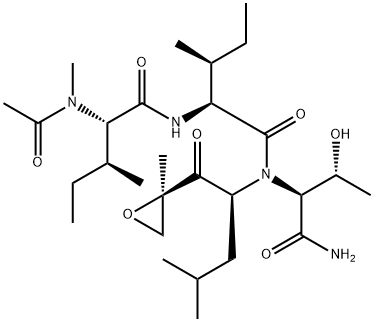
| Product Name: | EPOXOMICIN | | Synonyms: | BU-4061T;EPOXOMICIN, SYNTHETIC;EPOXOMICIN;(2R)-2-[ACETYL-(N-METHYL-L-ISOLEUCYL)-L-ISOLEUCYL-L-THREONYL-L-LEUCYL]-2-METHYLOXIRANE;n-acetyl-n-methyl-l-isoleucyl-l-isoleucyl-n-[(1s)-3-methyl-1-[[(2r)-2-methyloxiranyl]carbonyl]butyl]-l-threoninamide;Aids010837;Aids-010837;L-Threoninamide, N-acetyl-N-methyl-L-isoleucyl-L-isoleucyl-N-[(1S)-3-methyl-1-[[(2R)-2-methyloxiranyl]carbonyl]butyl]- | | CAS: | 134381-21-8 | | MF: | C28H50N4O7 | | MW: | 554.72 | | EINECS: | | Product Categories: | peptides;ProteasomeInhibitors | | Mol File: | 134381-21-8.mol |
| EPOXOMICIN Chemical Properties |
| Melting point | 107-109° | | alpha | D24.5 -66.1 ± 0.4° (c = 0.5 in MeOH) | | storage temp. | -20°C | | solubility | Soluble in DMSO (up to 10 mg/ml). | | form | solid | | color | White | | Stability: | Stable for 2 years from date of purchase as supplied. Solutions in DMSO may be stored at -20° for up to 2 months. | | InChIKey | DOGIDQKFVLKMLQ-JTHVHQAWSA-N |
| WGK Germany | 3 | | HS Code | 29299090 |
| EPOXOMICIN Usage And Synthesis |
| Description | Epoxomicin (134381-21-8) is a potent, selective and cell permeable irreversible inhibitor of the 20S proteasome.1 It does not inhibit non-proteasomal proteases such as papain, chymotrypsin, trypsin, calpain and cathepsin B at concentrations up to 50 μM.1 Epoxomicin was isolated from Actinomycete strain Q996-17 and displayed in vivo antitumor activity against B16 melanoma cells.2 Epoxomicin caused a progressive model of Parkinson’s disease in various systems.3,4,5 This model has been disputed.6,7 | | Uses | In studies of proteasome biology. | | Uses | Epoxomicin has been used:- as an ubiquitin–proteosome system (UPS) inhibitor in pheochromocytoma PC12 cells
- as a proteasome inhibitor in mammary epithelial MCF-10A cells
- as a proteasome inhibitor in chymotryptic assay in cardiomyocytes
| | Definition | ChEBI: A tripeptide consisting of an Ile-Ile-Thr-NH2 sequence N-substituted on the threonamide amidic nitrogen with a (2S)-4-methyl-1-[(2R)-2-methyloxiran-2-yl]-1-oxopentan-2-yl group and with acetyl and meth
l groups on the nitrogen of the isoleucine residue distal to the threonamide; a naturally occurring selective proteasome inhibitor with anti-inflammatory activity. | | General Description | Epoxomicin is a linear peptide consisting of a threonine or serine residue with α′, β′-epoxyketone?derived from leucine or a γ,δ-dehydroleucine. It is a natural product isolated from?Actinomyces?sp., and is a cell-permeable, potent, selective and irreversible proteasome inhibitor. | | Biochem/physiol Actions | Epoxomicin binds covalently to the catalytic subunits of proteasome. It forms an adduct with target proteins. It inhibits chymotrypsin-like activity of the proteasome. Epoxomicin also inhibits the nuclear factor κ light chain enhancer of activated B cells (NF-κB) mediated proinflammatory signalling pathway. It is also a potent antitumor and anti-inflammatory agent. | | References | 1) Meng et al. (1999), Epoxomicin, a potent and selective proteasome inhibitor, exhibits in vivo anti-inflammatory activity; Proc. Natl. Acad. Sci. USA, 96 10403
2) Hanada et al. (1992), Epoxomicin, a new antitumor agent of microbial origin; J. Antibiot. (Tokyo), 45 1746
3) McNaught et al. (2004), Systemic exposure to proteasome inhibitors causes a progressive model of Parkinson’s disease; Ann. Neurol., 56 149
4) Matsui et al. (2010), Proteasome inhibition in medaka brain induces the features of Parkinson’s disease; J. Neurochem., 115 178
5) Metcalfe et al. (2012), Coordination between proteasome impairment and caspase activation leading to TAU pathology:neuroprotection by cAMP; Cell Death Diff., 3 e326
6) Kordower et al. (2006), Failure of proteasome inhibitor administration to provide a model of Parkinson’s disease in rats and monkeys; Ann. Neurol., 60 264
7) Bove et al. (2006), Proteasome inhibition and Parkinson’s disease modeling; Ann. Neurol., 60 260 |
| EPOXOMICIN Preparation Products And Raw materials |
|


 日本语
日本语 한국어
한국어 Français
 Deutsch
 España
 Türkiye