Other grades of this product :
| KENPAULLONE Basic information |
| KENPAULLONE Chemical Properties |
| Melting point | >300°C (dec.) | | storage temp. | 2-8°C | | solubility | DMSO: 18 mg/mL, clear, yellow | | form | Yellow-brown solid | | color | yellow | | Stability: | Stable for 2 years from date of purchase as supplied. Solutions in DMSO may be stored at -20°C for up to 1 month. | | InChIKey | QQUXFYAWXPMDOE-UHFFFAOYSA-N | | CAS DataBase Reference | 142273-20-9(CAS DataBase Reference) |
| Hazard Codes | Xi | | Risk Statements | 36/37/38 | | Safety Statements | 26-36 | | WGK Germany | 3 |
| KENPAULLONE Usage And Synthesis |
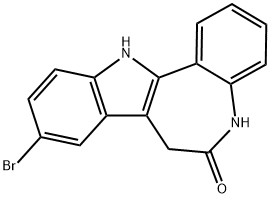
| Description | Kenpaullone (142273-20-9) inhibits GSK-3β (IC50=0.23 μM) as well as several cyclin-dependent kinases (CDKs), IC50=0.4, 0.68 and 0.85 μM for cdk1, cdk2 and cdk5 respectively.1-3 Induces pluripotent stem cells from somatic cells4 and increases direct neural conversion of human fibroblasts5 when used with other small molecules. Inhibits Kruppel-Like Factor 4 (KLF4) reducing autoimmune arthritis in the collagen-induced arthritis mouse model.6 | | Chemical Properties | Tan Solid | | Uses | The paullones are a novel class of kinase inhibitors, initially identified as CDK inhibitors. Kenpaullone has been found to be a useful GSK-3? inhibitor (IC50=23nM). | | Uses | Kenpaullone has been used:- as a glycogen synthase kinase 3 (GSK3)/ cyclin-dependent kinase (CDK) inhibitor to study its effects on human neural progenitor cell lines
- as an inhibitor of Krupple-like factor 4 (KLF4) in Gs-coupled designer GPCR (Gs DREADD= GsD) Agouti-related peptide (GsD-AgRP) mice
- as a GSK3/CDK inhibitor to study its effects on the sea urchin embryo development
| | Uses | The paullones are a novel class of kinase inhibitors, initially identified as CDK inhibitors. Kenpaullone has been found to be a useful GSK-3?inhibitor (IC50=23nM). | | General Description | A potent, cell-permeable, and reversible inhibitor of glycogen synthase kinase-3β (IC50 = 230 nM), Lck (IC50 = 470 nM), and cyclin-dependent kinases (Cdks). Inhibits Cdk1/cyclin B (IC50 = 400 nM), Cdk2/cyclin A (IC50 = 680 nM), Cdk2/cyclin E (IC50 = 7.5 μM), and Cdk5/p25 (IC50 = 850 nM). Also inhibits other kinases such as c-Src (IC50 = 15 μM), casein kinase II (IC50 = 20 μM), ERK1 (IC50 = 20 μM), and ERK2 (IC50 = 9 μM). Inhibition is competitive with respect to ATP binding. | | Biological Activity | Potent inhibitor of CDK1/cyclin B and GSK-3 β (IC 50 values are 0.4 and 0.23 μ M respectively). Also inhibits CDK2/cyclin A, CDK2/cyclin E and CDK5/cyclin/p35 (IC 50 values are 0.68, 7.5 and 0.85 μ M respectively). Selective over c-src (IC 50 = 15 μ M), casein kinase 2 (IC 50 = 20 μ M), ERK1 (IC 50 = 20 μ M), ERK2 (IC 50 = 9 μ M) and a range of other protein kinases (IC 50 values > 35 μ M). Generates induced pluripotent stem cells (iPSCs) from somatic cells when used in combination with reprogramming factors; can replace Klf4. | | Biochem/physiol Actions | Kenpaullone is also an inhibitor of glycogen synthase kinase 3β (GSK3β).?It also inhibits cyclin-dependent kinase 1 (CDK1/cyclin B), CDK2/cyclin A, CDK2/cyclin E, and CDK5/p25, majorly by competitive inhibition of adenosine triphosphate (ATP) binding. | | References | Zaharevitz et al. (1999), Discovery and initial characterization of the paullones, a novel class of small-molecule inhibitors of cyclin-dependent kinases; Cancer Res. 59 2566
Schultz et al. (1999) Paullones, a series of cyclin-dependent kinase inhibitor: synthesis, evaluation of CDK1/cyclin B inhibition, and in vitro antitumor activity; J.Med.Chem. 42 2909
Bain et al. (2003), The specificities of protein kinase inhibitors: an update; J. 371(Pt. 1) 199
Lyssiotis et al. (2009) Reprogramming of murine fibroblasts to induced pluripotent stem cells with chemical complementation of Klf4; Natl. Acad. Sci. USA 106 8912
Pfisterer et al. (2016), Small molecules increase direct neural conversion of human fibroblasts; Rep. 6 38290
Choi et al. (2018), Kruppel-Like Factor 4 Positively Regulates Autoimmune Arthritis in Mouse Models and Rheumatoid Arthritis in Patients via Modulating Cell Survival and Inflammation Factors of Fibroblast-Like Synoviocyte; Immunol. 9 1339 |
| KENPAULLONE Preparation Products And Raw materials |
|


 日本语
日本语 한국어
한국어 Français
 Deutsch
 España
 Türkiye