Other grades of this product :
| 2,3-BIS(4-HYDROXYPHENYL)-PROPIONITRILE Basic information |
| 2,3-BIS(4-HYDROXYPHENYL)-PROPIONITRILE Chemical Properties |
| Melting point | 200.0 to 204.0 °C | | RTECS | UG0900000 | | storage temp. | -20°C | | solubility | DMSO: soluble10mg/mL, clear | | form | powder | | color | white to beige | | Water Solubility | Soluble in 1eq. NaOH (30 mM), ethanol (100 mM), DMSO (100 mM), DMF (~30 mg/ml), and water (0.5 mg/ml at 25°C). | | Stability: | Stable for 1 year from date of purchase as supplied. Solutions in DMSO or ethanol may be stored at -20°C for up to 1 month. |
| Hazard Codes | Xi,N | | Risk Statements | 36-50 | | Safety Statements | 26-61 | | RIDADR | UN 3077 9 / PGIII | | WGK Germany | 3 | | HazardClass | 9 |
| 2,3-BIS(4-HYDROXYPHENYL)-PROPIONITRILE Usage And Synthesis |
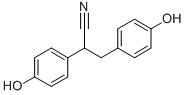
| Description | DPN (1428-67-7) is a potent estrogen ERβ receptor agonist. Displays a 70-fold selectivity over ERα, EC50 = 0.85 and 66 nM, respectively.1 Regulates expression of GluR1, 2 and 3 in rat hippocampus.2 Ameliorates portal hypertension in a carbon tetrachloride-induced liver cirrhosis rat model.3 Stimulates proliferation of androgen-independent prostate cancer cell line PC-3 via a novel pathway involving ERβ-mediated activation of β-catenin.4 A useful tool for elucidating the biological function of ERβ.5 | | Uses | 2,3-Bis(4-hydroxyphenyl)propionitrile is an estrogen receptor β and α specific with pro- and anti-nociceptive actions in mice. | | Definition | ChEBI: A nitrile that is acetonitrile in which one of the hydrogens is replaced by a 4-hydroxyphenyl group while a second hydrogen is replaced by a 4-hydroxybenzyl group. It is a specific agonist for estrogen receptor beta (ERbeta). | | Biological Activity | Highly potent estrogen ER β receptor agonist with a 70-fold selectivity over ER α (EC 50 values are 0.85 and 66 nM respectively). Relaxes mesenteric arteries in vitro . | | Biochem/physiol Actions | 2,3-Bis(4-hydroxyphenyl)-propionitrile (Diarylprepionitrile, DPN) is an ERβ-selective agonist; IC50 = 15nM. DPN protects WT and ARKO mice and significantly decreases IL-1β following LPS treatment in young adult-derived microglia. PPT (Cat. No.H6036, ERa agonist) enhances cell proliferation, while DPN inhibits it. PPT increases Bcl-2 expression, while DPN decreases it. DPN also elevates Bax expression. DPN induces a dose-dependent increase on vitellogenin synthesis. PPT and DPN are effective in dynamically, but differentially regulating intracellular calcium signaling in hippocampal neurons. DPN is more efficacious than PPT in potentiating a physiological concentration of glutamate-induced intracellular Ca2+ rise in these neurons. DPN prevents the development of prostatic hyperplasia and inflammation in testosterone-treated LuRKO mice. | | References | 1) Meyers et al. (2001), Estrogen receptor-beta potency-selective ligands: structure-activity relationship studies of diarylpropionitriles and their acetylene and polar analogues; J. Med. Chem., 44 4230
2) Waters et al. (2009), Estrogen receptor alpha and beta specific agonists regulate expression of synaptic proteins in rat hippocampus; Brain Res., 1290 1
3) Zhang et al. (2016), Role of estrogen receptor beta selective agonist in ameliorating portal hypertension in rats with CC14-induced liver cirrhosis; World J. Gastroenterol., 22 4484
4) Lombardi et al. (2016), Estrogen receptor beta (ERβ) mediates expression of β-catenin and proliferation in prostate cancer cell line PC-3; Mol. Cell. Endocrin. 430 12
5) Harrington et al. (2003), Activities of estrogen receptor alpha- and beta-selective ligands at diverse estrogen responsive gene sites mediating transactivation and transrepression; Mol. Cell. Endocrinol., 206 13 |
| 2,3-BIS(4-HYDROXYPHENYL)-PROPIONITRILE Preparation Products And Raw materials |
|


 日本语
 한국어
 Français
 Deutsch
 España
 Türkiye