Other grades of this product :
| (2R,6R)-Hydroxynorketamine Basic information |
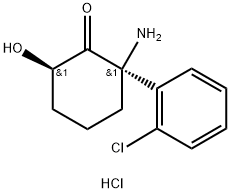
| Product Name: | (2R,6R)-Hydroxynorketamine | | Synonyms: | (2R,6R)-Hydroxynorketamine hydrochloride;(2R,6R)-2-amino-2-(2-chlorophenyl)-6-hydroxycyclohexanone hydrochloride;(2R,6R)-Hydroxynorketamine;(2R,6R)-Hydroxynorketamine hydrochloride >=98% (HPLC);(2R,6R)-2-amino-2-(2-chlorophenyl)-6-hydroxycyclohexan-1-onehydrochloride | | CAS: | 1430202-69-9 | | MF: | C12H15Cl2NO2 | | MW: | 276.16 | | EINECS: | | Product Categories: | | Mol File: | 1430202-69-9.mol |
| (2R,6R)-Hydroxynorketamine Chemical Properties |
| storage temp. | 2-8°C | | form | powder | | color | white to beige | | optical activity | [α]/D -95 to -115°, c = 1 in H2O |
| (2R,6R)-Hydroxynorketamine Usage And Synthesis |
| Biochem/physiol Actions | (2R,6R)-Hydroxynorketamine is a ketamine metabolite that has rapid antidepressant activity without ketamine-related side effects. The NMDAR antagonist (R,S)-ketamine must be metabolized to (2S,6S;2R,6R)-hydroxynorketamine (HNK) to have antidepressant effects. The (2R,6R)-HNK enantiomer appears to be the enantiomer most responsible for antidepressant effects in a mouse study and unlike (2S,6S)-HNK, (2R,6R)-HNK caused no significant changes in locomotion or coordination. (2R,6R)-HNK does not seem to have the same addiction potential as ketamine, since mice did not self-administer pharmacologically relevant doses of (2R,6R)-HNK under the same conditions where ketamine was readily self-administered. The (2R,6R)-HNK antidepressant appears to involve activation of AMPA glutamate receptors rather than inhibition of NMDA glutamate receptors. |
| (2R,6R)-Hydroxynorketamine Preparation Products And Raw materials |
|


 日本语
日本语 한국어
한국어 Français
 Deutsch
 España
 Türkiye