Other grades of this product :
| CCG-203971 Basic information |
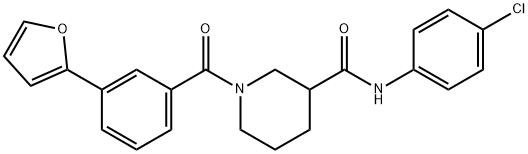
| Product Name: | CCG-203971 | | Synonyms: | CCG-203971;CCG 203971;CCG203971;CCG-203971;N-(4-Chlorophenyl)-1-[3-(2-furanyl)benzoyl]-3-piperidinecarboxamide;N-(4-chlorophenyl)-1-[3-(furan-2-yl)benzoyl]piperidine-3-carboxamide;203971;3-Piperidinecarboxamide, N-(4-chlorophenyl)-1-[3-(2-furanyl)benzoyl]- | | CAS: | 1443437-74-8 | | MF: | C23H21ClN2O3 | | MW: | 408.88 | | EINECS: | | Product Categories: | | Mol File: | 1443437-74-8.mol |
| CCG-203971 Chemical Properties |
| Boiling point | 656.0±55.0 °C(Predicted) | | density | 1.305±0.06 g/cm3(Predicted) | | storage temp. | 2-8°C | | form | powder | | pka | 13.69±0.70(Predicted) | | color | white to beige |
| CCG-203971 Usage And Synthesis |
| Uses | CCG 203971 acts as an antifibrotic agent, inhibiting fibrosis through targeting the MRTF/SRF gene transcription pathway. Inhibits the invasion of prostate cancer cells and acts as a potent anti-proliferative agent. | | Biochem/physiol Actions | CCG-203971 is an inhibitor of the Rho/MKL1/SRF transcriptional pathway, which has been shown to play a role in metastasis of melanoma and breast cancer and clinically associated with castration-resistant prostate cancer. CCG-203971 is a second-generation analog of CCG-1423 (SML0987) with an IC50 of 4.2 μM vs 1 μM for CCG-1423, but less cytotoxicity. In mouse studies, CCG-203971 inhibited invasion of PC-3 prostate cancer cells and was well tolerated up to doses of 100 mg/kg IP over 5 days. The Rho/MRTF/SRF pathway has also been shown to be involved in multiple types of solid organ fibrosis. CCG-203971 repressed both matrix-stiffness and TGF-β-mediated fibrogenesis in human colonic myofibroblasts and showed antifibrotic activity in a murine model of skin injury and in pulmonary fibrosis lung fibroblasts. |
| CCG-203971 Preparation Products And Raw materials |
|


 日本语
日本语 한국어
한국어 Français
 Deutsch
 España
 Türkiye