Other grades of this product :
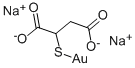
| Sodium aurothiomalate Basic information |
| Sodium aurothiomalate Chemical Properties |
| Water Solubility | Very soluble in water. Practically insoluble in alcohol, ether | | Merck | 14,4518 |
| Provider | Language |
|
ALFA
| English |
| Sodium aurothiomalate Usage And Synthesis |
| Physical properties | White to yellowish white powder; odorless; metallic taste; highly soluble in water; practically insoluble in ethanol and ether. | | Uses | Medicine (antirheumatic). | | Uses | Sodium aurothiomalate(I) is useful for high mobility group box chromosomal protein 1 western blotting. | | Definition | White to yellowish-white powder; odorless; metallic taste. Affected by light. Very soluble in water; practically insoluble in alcohol and ether; aqueous solutions are colorless to pale yellow; pH
(5% solution) 5.8–6.5. | | Production Methods | Gold(I) thiomalate is prepared by reacting sodium thiomalate with gold(I) halide. It is stored in the dark and otherwise protected from light. | | Brand name | Myochrysine (Merck). | | Pharmaceutical Applications | Sodium aurothiomalate is a commonly used gold-based DMARD and is indicated for active progressive
RA. It is administered by deep intramuscular injection. Administration is started with a test dose of 10mg
followed by weekly intervals of 50 mg doses. An improvement is expected to be seen once 300–500 mg
is administered. Treatment should be discontinued if there is no improvement after administering 1 g or
2months. Intervals of administration should be gradually increased to 4weeks in patients in whom an effect can be seen. If any blood disorders or other side effects such as GI bleedings or proteinuria are observed,
sodium aurothiomalate should be discontinued. | | Clinical Use | Active progressive rheumatoid arthritis in adults | | Safety Profile | Poison by
subcutaneous and intramuscular routes.
Moderately toxic bj intravenous ' route.
Human systemic effects: aggression,
agranulocytosis, aplastic anemia, cell count
changes, changes in circulation, cholestatic
jaunhce, dermatitis, encephalitis,
fasciculations, flaccid paralysis without
anesthesia, hemorrhage, hepatitis
(hepatocellular necrosis), increased body
temperature, interstitial fibrosis, muscle
weakness, proteinuria, recording from
peripheral motor nerve, depressed renal
function tests, somnolence, structural
changes in nerve sheath, thrombocytopenia,
uncharacterized allergc reaction, changes in
blood, teeth, and supporting structures.
Experimental teratogenic and reproductive
effects. When heated to decomposition it emits very toxic Na2O and SOx. | | Drug interactions | Potentially hazardous interactions with other drugs
ACE-inhibitors: flushing and hypotension reported
in combination.
Penicillamine: increased risk of toxicity - avoid. | | Metabolism | Mainly excreted in the urine with smaller amounts in the
faeces. |
| Sodium aurothiomalate Preparation Products And Raw materials |
|


 日本语
日本语 한국어
한국어 Français
 Deutsch
 España
 Türkiye