Other grades of this product :
| PROCYCLIDINE HYDROCHLORIDE Basic information |
| PROCYCLIDINE HYDROCHLORIDE Chemical Properties |
| Melting point | 159-164 °C | | storage temp. | 2-8°C | | solubility | Chloroform (Slightly), Methanol (Slightly), Water (Slightly) | | form | Solid | | color | White to Off-White |
| Hazard Codes | Xn | | Risk Statements | 20/21/22 | | Safety Statements | 36 | | WGK Germany | 3 | | RTECS | UY1926000 | | HS Code | 2933997500 |
| PROCYCLIDINE HYDROCHLORIDE Usage And Synthesis |
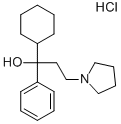
| Uses | An anticholinergic drug used in the treatment parkinson’s disease. It is also used to treat patients suffering from drug-induced parkinsonism, akathisia and acute dystonia. | | Brand name | Kemadrin (Monarch). | | General Description | Procyclidine hydrochloride,α-cyclohexyl-α-phenyl-1-pyrrolidinepropanolhydrochloride (Kemadrin), was introduced in 1956. Althoughit is an effective peripheral anticholinergic and, indeed, hasbeen used for peripheral effects similar to its methochloride(i.e., tricyclamol chloride), its clinical usefulness lies inits ability to relieve voluntary muscle spasticity by its centralaction. Therefore, it has been used with success in thetreatment of Parkinson syndrome. It is said to be as effectiveas trihexyphenidyl and is used to reduce muscle rigidityin postencephalitic, arteriosclerotic, and idiopathic types ofthe disease. Its effect on tremor is not predictable and probablyshould be supplemented by combination with othersimilar drugs.The toxicity of the drug is low, but when the dosageof the drug is high, side effects are noticeable. At therapeuticdosage levels, dry mouth is the most common sideeffect. The same care should be exercised with this drugas with all other anticholinergics when it is administeredto patients with glaucoma, tachycardia, or prostatichypertrophy. | | Biochem/physiol Actions | Procyclidine is a synthetic anti-cholinergic agent and atropine-like antispasmodic. It exhibits therapeutic effects against Parkinson′s disease and schizophrenia. Procyclidine acts as a muscarinic receptor antagonist. It also affects N-methyl-D-aspartate (NMDA) glutamine and nicotinic acetylcholine receptors to a lower extent. | | Clinical Use | Control of extrapyramidal symptoms
Acute dystonias | | Drug interactions | Potentially hazardous interactions with other drugs
None known | | Metabolism | When given orally about one fifth of the dose is known
to be metabolised in the liver, principally by cytochrome
P450 and then conjugated with glucuronic acid.
Metabolites have been found in the urine. |
| PROCYCLIDINE HYDROCHLORIDE Preparation Products And Raw materials |
|


 日本语
日本语 한국어
한국어 Français
 Deutsch
 España
 Türkiye