Other grades of this product :
| 7,7,8,8-Tetracyanoquinodimethane Basic information | | Applications |
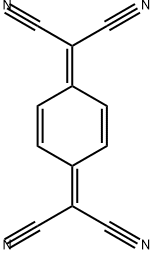
| Product Name: | 7,7,8,8-Tetracyanoquinodimethane | | Synonyms: | TIMTEC-BB SBB000435;Tetracyano p-Quinone Dimethane;2,2'-(2,5-cyclohexadiene-1,4-diylidene)bismalononitrile;2,5-Cyclohexadiene-delta(sup1alpha:4alpha)dimalononitrile;7,7,8,8-Tetracyano-1,4-chinodimethan;7,7,8,8-Tetracyano-1,4-quinodimethan;7,7,8,8-Tetracyanodimethan;7,7,8,8-Tetracyano-p-quinodimethane | | CAS: | 1518-16-7 | | MF: | C12H4N4 | | MW: | 204.19 | | EINECS: | 216-174-8 | | Product Categories: | Aromatic Nitriles;Acceptors (Charge Transfer Complexes);Charge Transfer Complexes for Organic Metals;Functional Materials;TCNQ Derivatives;oled materials | | Mol File: | 1518-16-7.mol |
| 7,7,8,8-Tetracyanoquinodimethane Chemical Properties |
| Melting point | 287-289 °C (dec.) (lit.) | | Boiling point | 332.67°C (rough estimate) | | density | 1.3596 (rough estimate) | | refractive index | 1.5000 (estimate) | | storage temp. | Sealed in dry,Room Temperature | | form | Crystalline Powder | | color | Orange-brown to green | | Water Solubility | insoluble | | λmax | 395nm(CH3CN)(lit.) | | BRN | 611604 | | Stability: | Stable. Incompatible with strong acids, strong bases, strong reducing agents, strong oxidizing agents. | | CAS DataBase Reference | 1518-16-7(CAS DataBase Reference) | | NIST Chemistry Reference | Propanedinitrile, 2,2'-(2,5-cyclohexadiene-1,4-diylidene)bis-(1518-16-7) | | EPA Substance Registry System | Propanedinitrile, 2,2'-(2,5-cyclohexadiene-1,4-diylidene)bis- (1518-16-7) | | Odor | Dark yellow to brown crystals/powder |
| 7,7,8,8-Tetracyanoquinodimethane Usage And Synthesis |
| Applications | 7,7,8,8-tetracyanoquinodimethane (TCNQ), with a LUMO at 4.5 eV, is known for the charge-transfer salts formed by its radical anion TCNQ in photovoltaic, light-emitting diodes, and organic field-effect transistor devices. TCNQ and its derivatives have been used as dopants, leading to an increase in hole mobility or to the lowering of injection barriers. One classic example of such is the treatment of tetrathiafulvene (TTF), an electron donor with TCNQ. TFF and TCNQ form an ion pair, the TTF-TCNQ complex. This process of doping leads to the crystallisation of the ion pair into a one-dimensionally stacked polymer. This polymer consists of segregated stacks of cations and anions of the donors and the acceptors, respectively. The complex crystal is an organic semiconductor that exhibits metallic electric conductivity.
It also has been shown that TCNQ can effectively modify Cu or Ag surfaces. The formation of Cu-TCNQ and Ag-TCNQ enhances the work function of such electrodes and reduces the hole injection barrier dramatically. Furthermore, it improves electrode/organic layer contact, hence the reduction of contact resistances.
Tetracyanoquinodimethane (TCNQ) is also found to act as a p-type doping agent of graphene films due to its powerful electron-accepting capacity.
| | Description | 7,7,8,8-tetracyanoquinodimethane (TCNQ), with a LUMO at 4.5 eV, is known for the charge-transfer salts formed by its radical anion TCNQ in?photovoltaic, light-emitting diodes, and organic field-effect transistor?devices. TCNQ and its derivatives?have been used as dopants, leading to an increase in hole mobility or to the lowering of injection?barriers. One classic example of such is the treatment of tetrathiafulvene (TTF), an electron donor with TCNQ. TFF and TCNQ form an ion pair, the TTF-TCNQ complex. This process of doping leads to the crystallisation of the ion pair into a one-dimensionally stacked polymer. This polymer consists of segregated stacks of cations and anions of the donors and the acceptors, respectively. The complex crystal is an organic semiconductor that exhibits metallic electric conductivity [1, 2]. | | Chemical Properties | orange to green crystalline powder | | Uses | 7,7,8,8-Tetracyanoquinodimethane is an electron-acceptor molecule used to form charge-transfer superconductors. It is an effective catalyst used for the ?-chlorination of carboxylic acids using chlorosulfonic acid; the presence of TCNQ suppresses competing free-radical chlorination. | | Definition | ChEBI: A quinodimethane that is p-quinodimethane in which the methylidene hydrogens are replaced by cyano groups. | | Synthesis Reference(s) | Journal of the American Chemical Society, 84, p. 3370, 1962 DOI: 10.1021/ja00876a028The Journal of Organic Chemistry, 48, p. 1366, 1983 DOI: 10.1021/jo00156a048 | | General Description | 7,7,8,8-Tetracyanoquinodimethane (TNCQ) is a strong electron acceptor as it has four cyano groups and π-conjugation bonds that form charge transferring chains and ion radical salts which are mainly used as p-dopants for the fabrication of a variety of semiconductor applications. |
| 7,7,8,8-Tetracyanoquinodimethane Preparation Products And Raw materials |
|


 日本语
日本语 한국어
한국어 Français
 Deutsch
 España
 Türkiye