| Chemical Properties | Sulpiride is White Solid
|
| Originator | Dogmatil,Delagrange,France,1969 |
| Uses | Sulpiride is an antipsychotic drug used in the treatment of Schozophrenia and depression.
|
| Uses | dopamine receptor antagonist, antipsychotic |
| Uses | Sulpiride possesses moderate neuroleptic activity along with some stimulating and antidepressant effects. It has antiemetic, moderately cataleptogenic, and antiserotonin action. It
facilitates increased blood flow in the stomach. It speeds up the restorative processes in tissues. It is used for schizophrenia, depression, migraines, disturbance of behavioral functions, and stomach and duodenal ulcers. |
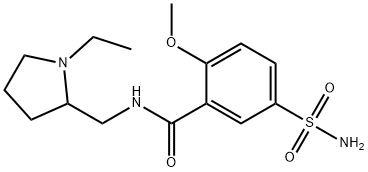
| Definition | Sulpiride is a member of the class of benzamides obtained from formal condensation between the carboxy group of 2-methoxy-5-sulfamoylbenzoic acid and the primary amino group of (1-ethylpyrrolidin-2-yl)methylamine.
|
| Manufacturing Process | 1-Ethyl-2-aminomethylpyrrolidine is reacted with 2-methoxy-5-
sulfamoylbenzoic acid to give sulpiride. |
| Brand name | Dogmatyl (Laboratoires Delagrange, France). |
| Therapeutic Function | Tranquilizer, Digestive aid |
| Biological Activity | Standard D 2 -like dopamine receptor antagonist. |
| Biochem/physiol Actions | (±)-Sulpiride is a D2 dopamine antagonist and an effective treatment for schizophrenia when used in combination with clozapine, a relatively weak D2-dopaminergic antagonist. It is an antipsychotic agent and also exhibits neuroleptic properties but poorly penetrates the central nervous system.45,46 |
| Clinical Use | Antipsychotic:
Acute and chronic schizophrenia |
| Synthesis | Sulpiride, N-[(1-ethyl-2-pirrolidinylmethyl]-5-sulfamoyl-O-anizamide (6.7.2),
is synthesized from 5-aminosulfosalycilic acid. Methylating this with dimethylsulfate
gives 2-methoxy-5-aminosulfonylbenzoic acid (6.7.1), which is transformed into an amide
using 2-aminomethyl-1-ethylpyrrolidine as amine components and carbonyl-1,1′-bisimidazole as a condensing agent [70–74]. |
| Drug interactions | Potentially hazardous interactions with other drugs
Anaesthetics: enhanced hypotensive effect.
Analgesics: increased risk of convulsions with
tramadol; enhanced hypotensive and sedativeeffects with opioids; increased risk of ventricular
arrhythmias with methadone.
Anti-arrhythmics increased risk of ventricular
arrhythmias with anti-arrhythmics that prolong the
QT interval, e.g. procainamide, disopyramide and
amiodarone - avoid with amiodarone.
Antibacterials: increased risk of ventricular
arrhythmias with moxifloxacin and parenteral
erythromycin - avoid with moxifloxacin.
Antidepressants: possibly increased risk of
ventricular arrhythmias and antimuscarinic side
effects with tricyclics - avoid.
Antiepileptics: antagonism (convulsive threshold
lowered).
Antimalarials: avoid with artemether/lumefantrine.
Antipsychotics: increased risk of ventricular
arrhythmias with droperidol, haloperidol and
pimozide - avoid; possible increased risk of
ventricular arrhythmias with risperidone.
Antivirals: concentration possibly increased by
ritonavir.
Anxiolytics and hypnotics: increased sedative effects.
Atomoxetine: increased risk of ventricular
arrhythmias.
Beta-blockers: enhanced hypotensive effect;
increased risk of ventricular arrhythmias with sotalol.
Cytotoxics: increased risk of ventricular arrhythmias
with vandetanib - avoid; increased risk of ventricular
arrhythmias with arsenic trioxide.
Diuretics: enhanced hypotensive effect.
Lithium: increased risk of extrapyramidal side effects
and possibly neurotoxicity.
Pentamidine: increased risk of ventricular
arrhythmias. |
| Metabolism | Sulpiride undergoes little metabolism.
95% of a dose is excreted in the urine and faeces, mainly
as unchanged drug. |


 日本语
日本语 한국어
한국어 Français
 Deutsch
 España
 Türkiye