Other grades of this product :
| SPHINGOSYLPHOSPHORYLCHOLINE Basic information |
| SPHINGOSYLPHOSPHORYLCHOLINE Chemical Properties |
| Melting point | 90-102°C | | storage temp. | -20°C | | solubility | chloroform/methanol (2:1): complete10 mg/ml, clear to slightly hazy, colorless to light yellow | | form | powder | | color | light yellow | | BRN | 7342520 |
| SPHINGOSYLPHOSPHORYLCHOLINE Usage And Synthesis |
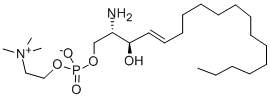
| Chemical Properties | Yellowish Waxy Solid | | Uses | Involved in cell regulation, and transmembrane signaling. A putative lipid second messenger, connected via Protein Kinase C to the phosphatidylinositol-derived second messengers for signal transduction. | | Uses | Neurotrophic effects of Sphingosylphosphorylcholine were studied in cerebellar granule neurons of mice and PC-12 cells. | | Uses | Lyso SM (d18:1) has been used: - to study its effect on the skeletal muscle ryanodine receptor (RyR1), in the presence and absence of calmodulin through single channel recordings in planar lipid bilayers
- as an inhibitor of Ca2+ sensor calmodulin (CaM)
- as a standard in circular dichroism (CD) spectroscopy to determine lipid selectivity of the lipid-peptide interactions
| | General Description | Lyso SM (d18:1), also known as sphingosylphosphorylcholine (SPC), is a bioactive lipid molecule. This lysophospholipid is present in normal blood plasma, ascites and various tissues. | | Biochem/physiol Actions | Sphingosylphosphorylcholine (SPC) is a bioactive lipid that mediates intracellular and extracellular signaling. It mobilizes Ca2+ from intracellular stores via an IP3-independent pathway. It stimulates the production of CCL2 that may contribute to development of atherosclerosis. SPC is a ligand for endothelial differentiation gene receptor 3 (EDG3). |
| SPHINGOSYLPHOSPHORYLCHOLINE Preparation Products And Raw materials |
|


 日本语
日本语 한국어
한국어 Français
 Deutsch
 España
 Türkiye