Other grades of this product :
| 4-AMINO-1,8-NAPHTHALIMIDE Basic information |
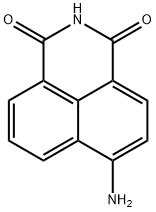
| Product Name: | 4-AMINO-1,8-NAPHTHALIMIDE | | Synonyms: | 4-Amino-1,8-naphthalenedicarbimide;4-Amino-1,8-naphthalenedicarboximide;4-Aminonaphthalene-1,8-dicarbimide;6-Amino-2,3-dihydro-1H-benzo[de]isoquinoline-1,3-dione;6-Amino-2H-benzo[de]isoquinoline-1,3-dione;4-Amino-1,8-naphthalimide,98%;6-amino-1h-benz(de)isoquinoline-3(2h)-dione;6-amino-1h-benz[de]isoquinoline-3(2h)-dione | | CAS: | 1742-95-6 | | MF: | C12H8N2O2 | | MW: | 212.2 | | EINECS: | 217-110-1 | | Product Categories: | Aromatic Carboxylic Acids, Amides, Anilides, Anhydrides & Salts;PARP (Poly(ADP-Ribose) polymerase);PARP InhibitorsEnzyme Inhibitors by Enzyme;PARP Poly(ADP-ribose) PolymeraseCancer Research;Antitumor Agents;Apoptosis and Cell Cycle;P to;Therapy Adjuncts | | Mol File: | 1742-95-6.mol |
| 4-AMINO-1,8-NAPHTHALIMIDE Chemical Properties |
| Melting point | 360 °C | | Boiling point | 352.04°C (rough estimate) | | density | 1.105 g/mL at 25 °C(lit.) | | vapor pressure | 0Pa at 25℃ | | refractive index | 1.6000 (estimate) | | storage temp. | -20°C | | solubility | Soluble in DMSO | | form | Orange solid. | | pka | 9.53±0.20(Predicted) | | Water Solubility | 354mg/L at 25℃ | | LogP | 1.08 | | CAS DataBase Reference | 1742-95-6 | | EPA Substance Registry System | 1H-Benz[de]isoquinoline-1,3(2H)-dione, 6-amino- (1742-95-6) |
| Hazard Codes | Xi | | Risk Statements | 36/37/38 | | Safety Statements | 26-37/39 | | WGK Germany | 3 | | RTECS | DE4081000 | | TSCA | Yes | | HS Code | 29251995 |
| 4-AMINO-1,8-NAPHTHALIMIDE Usage And Synthesis |
| Description | The poly(ADP-ribose) polymerases (PARPs) form a family of enzymes with roles in DNA repair and apoptosis, particularly in response to reactive oxygen and nitrogen species. 4-amino-1,8-Naphthalimide (4-ANI) is an inhibitor of PARP (IC50 = 180 nM). It blocks radiation-induced PARP in cancer cells, potentiating the cytotoxicity of γ-radiation, although it is not cytotoxic in the absence of radiation. 4-ANI is used to study the role of PARP activity in various cell systems. | | Chemical Properties | orange amorphous powder | | Uses | The poly(ADP-ribose) polymerases (PARPs) form a family of enzymes with roles in DNA repair and apoptosis, particularly in response to reactive oxygen and nitrogen species. 4-amino-1,8-Naphthalimide (4-ANI) is an inhibitor of PARP (IC50 = 180 nM). It blocks radiation-induced PARP in cancer cells, potentiating the cytotoxicity of γ-radiation, although it is not cytotoxic in the absence of radiation. 4-ANI is used to study the role of PARP activity in various cell systems. | | Biochem/physiol Actions | 4-Amino-1,8-naphthalimide sensitizes cells to radiation-induced cell damage and enhances the cytotoxicity of 1-methyl-3-nitro-1-nitrosoguanidine. | | Enzyme inhibitor | This PARP inhibitor (FW = 212.21 g/mol) is a strong inhibitor of NAD:ADP-ribosyltransferase or poly(ADP-ribose) polymerase (IC50 = 0.18 μM). In addition, 4-Amino-1,8-naphthalimide is a radiation sensitizer at non-toxic and low concentrations. | | references | [1]. schlicker a, peschke p, bürkle a, et al. 4-amino-1,8-naphthalimide: a novel inhibitor of poly(adp-ribose) polymerase and radiation sensitizer. int j radiat biol. 1999 jan;75(1):91-100.[2]. davar d1, beumer jh, hamieh l, et al. role of parp inhibitors in cancer biology and therapy. curr med chem. 2012;19(23):3907-21.[3]. banasik m, komura h, shimoyama m,et al. specific inhibitors of poly(adp-ribose) synthetase and mono(adp-ribosyl)transferase. j biol chem. 1992 jan 25;267(3):1569-75.[4]. issaeva n, thomas hd, djureinovic t, et al. 6-thioguanine selectively kills brca2-defective tumors and overcomes parp inhibitor resistance. cancer res. 2010 aug 1;70(15):6268-76. |
| 4-AMINO-1,8-NAPHTHALIMIDE Preparation Products And Raw materials |
|


 日本语
日本语 한국어
한국어 Français
 Deutsch
 España
 Türkiye