Other grades of this product :
| PHALLOIDIN Basic information |
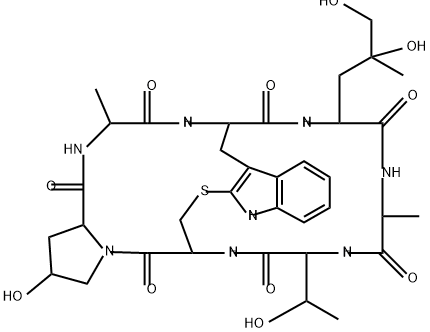
| Product Name: | PHALLOIDIN | | Synonyms: | Phalloidin, Amanita phalloides - CAS 17466-45-4 - Calbiochem;Phalloidin trifluoroacetate salt;pto-l-tryptophyl-4,5-dihydroxy-l-leucyl),cyclic(3,6)-sulfide;PHALLOIDIN;PHALLOIDIN, AMANITA PHALLOIDES;PHALLOIDIN FROM AMANITA PHALLOIDES;Cyclo(L-Ala-D-Thr-L-Cys(1)-L-c4Hyp-L-Ala-L-Trp2(1)-4,5'-dihydroxy-L-Leu-);Cyclic(L-alanyl-D-threonyl-L-cysteinyl-cis-4-hydroxy-L-prolyl-L-alanyl-2-mercapto-L-tryptophyl-4,5-dihydroxy-L-leucyl), cyclic (3.fwdarw.6)-sulfide | | CAS: | 17466-45-4 | | MF: | C35H48N8O11S | | MW: | 788.87 | | EINECS: | 241-484-5 | | Product Categories: | marker | | Mol File: | 17466-45-4.mol |
| PHALLOIDIN Chemical Properties |
| Melting point | 280-282° | | alpha | +55.7°(D/20℃)(c=0.5,メタノール) | | density | 1.1612 (rough estimate) | | refractive index | 1.7400 (estimate) | | storage temp. | +2C to +8C | | form | White crystalline solid | | Boiling point | 1370.5±65.0 °C(Predicted) | | pKa | 13.03±0.70(Predicted) | | color | Hexahydrate, needles or crystals from water | | Merck | 13,7273 | | BRN | 4347460 | | Stability: | Stable. Incompatible with strong oxidizing agents. |
| Hazard Codes | T+ | | Risk Statements | 26/27/28 | | Safety Statements | 22-28-36/37-45 | | RIDADR | UN 3462 6.1/PG 2 | | WGK Germany | 3 | | RTECS | SE9800000 | | F | 18 | | HazardClass | 6.1(a) | | PackingGroup | I | | HS Code | 2934999090 | | Hazardous Substances Data | 17466-45-4(Hazardous Substances Data) | | Toxicity | LD50 i.m. in albino mice: 3.3 mg/g (Vogt); LD50 i.p. in mice: 2 mg/kg (Wieland, Wieland) |
| PHALLOIDIN Usage And Synthesis |
| Description | Phalloidin is a natural mycotoxin first isolated from the death cap mushroom, A. phalloides. It binds F-actin and stabilizes actin fibers. Fluorescently labeled phalloidin is commonly used to stain F-actin in cells. | | Chemical Properties | white powder | | Uses | Phalloidin has been used: - As a supplement in PEM buffer and dimethyl sulfoxide (DMSO).
- As a drug.
- In immunohistochemistry to stain F-actin.
| | Definition | ChEBI: A homodetic bicyclic heptapeptide having a sulfide bridge. | | General Description | Phalloidin is a phallotoxin produced by death cap mushroom Amanita phalloides. It is a cyclic peptide, which interacts with actin, and this was first identified in phalloidin-poisoned rats. It is a heptapeptide, cyclic in nature, with a crosslink between tryptophan at position 6 and cysteine at position 3. The side chain of amino acid 7 (γ-δ-dihydroxyleucine) in phalloidin, is accessible to modifications, through which fluorescently labeled phalloidin compounds can be produced. | | Biochem/physiol Actions | Toxin that binds polymeric F actin, stabilizing it and interfering with the function of actin-rich structures. | | Safety Profile | Poison by ingestion, intraperitoneal, and intravenous routes. Mutation data reported. Whenheated to decomposition it emits toxic fumes of SOx, and NOx. | | Enzyme inhibitor | This bicyclic heptapeptide toxin (FW = 788.88 g/mol; CAS 17466-45-4) is was first isolated from the poisonous green fungus Amanita phalloides. Primary Mode of Action: Phalloidin binds preferentially to filamentous actin; little or no binding to globular actin has been detected. such preferential action stimulates actin polymerization, and phalloidin lowers the actin monomer critical concentration by 30x, from 50-100 nM down to 2-3 nM. When present at 1 to 10 concentration ratio of phalloidin to total actin subunits, actin filaments are also greatly stabilized toward depolymerization. Effects on Actin Filaments: Cellular processes requiring filament disassembly are likewise inhibited. Depolymerization of F-actin by cytochalasins, potassium iodide, and elevated temperatures are inhibited by phalloidin binding. Because the toxin and its fluorescent derivatives are relatively small, a wide variety of actin-binding proteins can still bind to phalloidin-labeled filamentts. Perhaps more significantly, phalloidin-labeled actin filaments retain many of their functional properties, such that phalloidin-labeled, glycerinated muscle fibers can still contract, and labeled actin filaments still move on myosin that has been tethered to solid-phase substrates. Phalloidin can be also be used to assess the relativeconcentrations of these two forms of actin as well as a means to label actin filaments in a cell (See Phallacidin). |
| PHALLOIDIN Preparation Products And Raw materials |
|


 日本语
日本语 한국어
한국어 Français
 Deutsch
 España
 Türkiye