Other grades of this product :
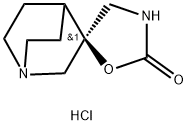
| AR-R 17779 hydrochloride Basic information |
| Product Name: | AR-R 17779 hydrochloride | | Synonyms: | (3S)-Spiro[1-azabicyclo[2.2.2]octane-3,5'-oxazolidine]-2'-one hydrochloride;AR-R 17779 hydrochloride, >=98%;AR-R17779 Hydrochloride >=97% (HPLC) | | CAS: | 178419-42-6 | | MF: | C9H15ClN2O2 | | MW: | 218.68 | | EINECS: | | Product Categories: | | Mol File: | 178419-42-6.mol |
| AR-R 17779 hydrochloride Chemical Properties |
| storage temp. | -20°C | | solubility | <10.93mg/ml in DMSO; <21.87mg/ml in H2O | | form | powder | | color | white to beige | | optical activity | [α]/D -59 to -69°, c = 1.0 in methanol |
| AR-R 17779 hydrochloride Usage And Synthesis |
| Uses | AR-R 17779 Hydrochloride is a selective α7 nicotinic receptor agonist. | | Biological Activity | ar-r 17779 is a selective agonist of α7 nicotinic acetylcholine receptor (α7-nachr) [1] with an ec50 of 21 μm to rat α7-nachrs expressed in xenopus oocytes [2].nicotine enhances cognitive functions, e.g. learning, attention, retention and memory in both humans and animals, via activation of brain nicotinic acetylcholine receptors (nachrs). these receptors are homo- or heteropentameric ligand-gated ion channels. the most common nicotinic receptors found in the brain are the α4β2-nachr and the α7-nachr [3].the expression of cd38, cd138, and bcl-6, was sensitive to regulation via nachrs. daudi cells exposed to ar-r 17779 ± methyllycaconitine (mla) resulted in only moderate changes in the gene expression of cd38, cd138 and bcl-6, but ar-r 17779 alone significantly (p< 0.05) increased protein levels of cd38 and cd138. that means the effect of ar-r 17779 was abolished by mla [4].cholesterol is necessary for the homeostasis of acetylcholine receptor (achr) levels for ion translocation and at the plasmalemma [5]. in apoe-deficient mice, ar-r 17779 significantly reduced atherosclerotic plaque area in the thoracic aorta, and lowered heart rate, blood pressure, serum triglyceride level and serum total cholesterol level compared with which in ang ii + hfd mice. treatment with ar-r 17779 in mice did not result in any sickness behavior or apparent abnormalities. at the end of the experiment, the serum concentration of ar-r 17779 was 1.18 ± 0.17 μm. in apoe-deficient mice, treatment with ar-r 17779 resulted in significantly reduced aortic diameter comparable to control mice (0.81 ± 0.11 mm, p< 0.0001 vs. ang ii + hfd) [1]. | | Biochem/physiol Actions | AR-R17779 is a nicotinic acetylcholine receptor alpha7 full agonist that targets α7 nAChR with high affinity (Ki = 92 nM/rat α7 against 5 nM α-BTX vs.16 μM/rat α4β2 against 3 nM (-)-nicotine) and selectivity (EC50 = 6.2/10/12.7 μM using human/rat/monkey α7 nAChR-Xenopus oocyte by whole cell voltage clamp, no antagonistic activity against acetylcholine using human α4β2-, α3β4-, α3β2-, α3β2α5-expressing oocytes or antagonistic activity against 5-HT using rat 5HT3a-exxpressing oocytes). AR-R17779 exhibits cognition-improving efficacy in rats (1-20 mg/kg s.c) and mice (1-20 mg/kg i.p.) in vivo and is widely employed for studying other α7 nAChR-dependent physiological functions. | | references | [1]. toru hashimoto, toshihiro ichiki, ayawatanabe, et al. stimulation of α7 nicotinic acetylcholine receptor by ar-r17779 suppresses atherosclerosis and aortic aneurysm formation in apolipoprotein e-deficient mice. vascular pharmacology, 2014, 61:49-55.[2]. rudy schreiber, marion dalmus and jean de vry. effects of α4/β2- and α7-nicotine acetylcholine receptor agonists on prepulse inhibition of the acoustic startle response in rats and mice. psychopharmacology, 2002, 159:248-257.[3]. marja van kampen, karin selbach, renate schneider, et al. ar-r 17779 improves social recognition in rats by activation of nicotinic α7 receptors. psychopharmacology, 2004, 172:375-383.[4]. juan arredondo, denys omelchenko, alexander i chernyavsky, et al. functional role of the nicotinic arm of the acetylcholine regulatory axis in human b-cell lines. journal of experimental pharmacology, 2009, 1:1-7.[5]. virginia borroni and francisco j. barrantes. cholesterol modulates the rate and mechanism of acetylcholine receptor internalization. j. biol. chem., 2011, 286(19):17122-32. |
| AR-R 17779 hydrochloride Preparation Products And Raw materials |
|


 日本语
 한국어
 Français
 Deutsch
 España
 Türkiye