Other grades of this product :
| CYCLOPIAZONIC ACID Basic information |
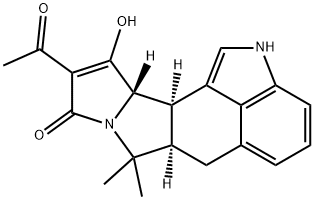
| Product Name: | CYCLOPIAZONIC ACID | | Synonyms: | -Cyclopiazonic acid / CPA;Cyclopiazonic acid from Penicillium grisefulvum;Cyclopiazonic acid (CPA);Cyclopiazonic acid, FroM PenicilliuM griseofulvuM;(6aR,11aS,11bR)-10-acetyl-11-hydroxy-7,7-dimethyl-2,6,6a,7,11a,11b-hexahydro-9H-pyrrolo[1',2':2,3]isoindolo[4,5,6-cd]indol-9-one;Cyclopiazonic acid, 98%, from Penicillium griseofulvum;Cyclopiazonic Acid, Penicillium cyclopium - CAS 18172-33-3 - Calbiochem;(6a-alpha,11a,11b-alpha)--10-acetyl-7-dimethyl-11-hydroxy- | | CAS: | 18172-33-3 | | MF: | C20H20N2O3 | | MW: | 336.38 | | EINECS: | | Product Categories: | antibiotic;Signalling;Calcium signaling | | Mol File: | 18172-33-3.mol |
| CYCLOPIAZONIC ACID Chemical Properties |
| Melting point | 245-246°C | | Boiling point | 472.86°C (rough estimate) | | density | 1.2171 (rough estimate) | | refractive index | 1.5700 (estimate) | | storage temp. | -20°C | | solubility | DMSO: soluble | | form | powder | | pka | 4.50±1.00(Predicted) | | color | white to off-white | | Water Solubility | Soluble in DMSO (100 mM), ethanol (5 mM), DMF (~20 mg/ml), and 1:1 DMSO:PBS(pH 7.2) (0.5 mg/ml). Insoluble in water. | | EPA Substance Registry System | Cyclopiazonic acid (18172-33-3) |
| CYCLOPIAZONIC ACID Usage And Synthesis |
| Description | Cyclopiazonic acid is a mycotoxin that has been found in Penicillium and Aspergillus and an inhibitor of sarcoplasmic/endoplasmic reticulum Ca2+-ATPase (SERCA; IC50 = 0.6 μM). In vivo, cyclopiazonic acid (11-14 mg/kg) induces ptosis, hypothermia, tremor, and cachexia, as well as induces lethality (LD50 = 13 mg/kg), in rats. It induces tachycardia and sedation in rabbits when administered at a dose of 10 mg/kg. | | Chemical Properties | off-white powder or crystals | | Uses | Cyclopiazonic acid is a tremorigenic indole produced by several species of Aspergillus and Penicillium. Cyclopiazonic acid is a highly specific inhibitor of calcium ATPase of sarcoplasmic reticulum, altering calcium homeostasis and ATP-dependent calcium transport and resulting in the release of intracellular stored Ca2+ without increasing IP3. | | Uses | The use of Cyclopiazonic acid on Langendorff-perfused murine hearts displayed anti-arrhythmic effects. Also, administration of cyclopiazonic acid on rat soleus muscle showed a decrease in hormone sensitive lipase activity and triacylglycerol hydrolysis. It is also used as an inhibitor of endoplasmic reticulum Ca2+-ATPase. | | Uses | Cyclopiazonic acid from?Penicillium cyclopium has been used:- as a standard in aflatoxin detection and quantification by thin layer chromatography (TLC)
- as a component in Ca2+-free DMEM/10% fetal bovine serum (FBS)
- as a reversible inhibitor of the sarco/endoplasmic reticulum Ca2+-ATPase (SERCA) to examine the role of luminal calcium in endoplasmic recticulum (ER)-to-Golgi trafficking
- as an endoplasmic reticulum Ca2+-ATPase blocker, to treat neurons and also to study the role of the endoplasmic reticulum (ER) in releasing and sustaining Ca2+?during Ca2+-induced Ca2+ release (CICR) to inhibit SERCA
| | General Description | Cyclopiazonic acid (CPA), a tetramic acid is synthesized by various Aspergillus and Penicillium species. | | Biological Activity | Cell-permeable, reversible inhibitor of sarcoplasmic reticulum Ca 2+ -ATPase. | | Biochem/physiol Actions | Inhibits the sarcoplasmic reticulum Ca2+-pump. |
| CYCLOPIAZONIC ACID Preparation Products And Raw materials |
|


 日本语
日本语 한국어
한국어 Français
 Deutsch
 España
 Türkiye