Other grades of this product :
| LACTACYSTIN Basic information |
| LACTACYSTIN Chemical Properties |
| Melting point | 233-235°C dec. | | Boiling point | 714.9±60.0 °C(Predicted) | | density | 1.367±0.06 g/cm3(Predicted) | | storage temp. | -20°C | | solubility | Soluble in DMSO (up to 20 mg/ml), in Water (up to 10 mg/ml), or in Ethanol (up to 1 mg/ml). | | pka | 3.11±0.10(Predicted) | | form | powder | | color | White to off-white | | Stability: | Stable for 2 years from date of purchase as supplied. Solutions in DMSO or ethanol may be stored at -20° for up to 1 month. Solutions in water are not stable and must be used with one working day. Aqueous solutions should not be stored. |
| LACTACYSTIN Usage And Synthesis |
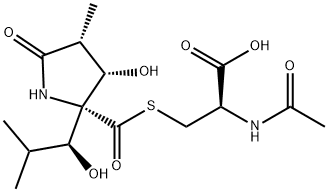
| Description | Lactacystin is a microbial metabolite isolated from Streptomyces that is now widely used as a selective inhibitor of the 20S proteasome. Lactacystin was first characterized by its ability to induce differentiation and inhibit cell cycle progression in several tumor cell lines. At concentrations from 2 to 10 μM, lactacystin induces the outgrowth of neurites in the neuroblastoma cell line Neuro2a. Lactacystin irreversibly alkylates subunit X of the 20S proteasome. The concomitant inhibition of proteasome peptidase activity results in the accumulation of a variety of ubiquitinated proteins which would normally undergo rapid degradation. Thus, the effects of lactacystin are pleiotropic and depend substantially on the expression pattern of signalling proteins within the treated cell. | | Chemical Properties | White Powder | | Uses | A selective and potent inhibitor of proteasome-mediated degradation of ubiquitin-tagged proteins. A Streptomyces metabolite that acts as a highly specific inhibitor of the 20S proteasome (MCP: multicatalytic proteinase complex) | | Uses | Lactacystin has been used:- as a proteasome inhibitor to inhibit protein degradation
- to inhibit proteasomal activity of cells for live cell imaging
- to block proteasomal proteolysis in human monocyte-derived dendritic cells (MoDCs) for 24 h
- to provide unilateral injection to animals to induce nigrostriatal lesions
| | Definition | ChEBI: L-Cysteine substituted at nitrogen by an acetyl group and at sulfur by a substituted-lactam carbonyl group. | | General Description | Lactacystin is an antibiotic?and a metabolite of Streptomyces?spp. | | Biochem/physiol Actions | Lactacystin can block the development of cell cycle and stimulate differentiation in a murine neuroblastoma cell line. It can serve as a precursor for?clasto-lactacystin β-lactone. Cell-permeable and irreversible proteasome inhibitor (Ki = 4nM). Inhibits NF-kB activation (IC50 = 10mM). Induces neurite outgrowth in neuro2A mouse neuroblastoma cells. | | References | 1) Omura et al. (1991), Lactacystin, a novel microbial metabolite, induces neuritogenesis of neuroblastoma cells; J. Antibiot., 44 113
2) Fenteany et al. (1995), Inhibition of proteasome activities and subunit-specific amino-terminal threonine modification by lactacystin; Science, 268 726 |
| LACTACYSTIN Preparation Products And Raw materials |
|


 日本语
日本语 한국어
한국어 Français
 Deutsch
 España
 Türkiye