Other grades of this product :
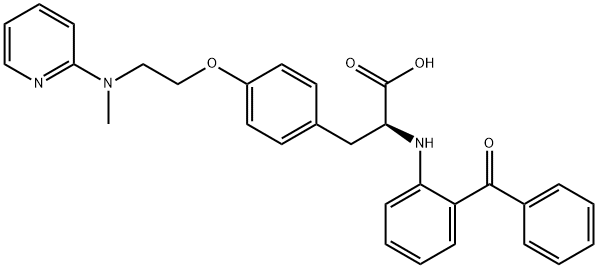
| Product Name: | GW1929 | | Synonyms: | GW1929;GW1929 HYDRATE;N-(2-Benzoylphenyl)-O-[2-(methyl-2-pyridinylamino)ethyl]-L-tyrosine hydrate;(2S)-2-(2-benzoylanilino)-3-[4-[2-[methyl(pyridin-2-yl)amino]ethoxy]phenyl]propanoic acid;(S)-2-(2-Benzoylphenylamino)-3-(4-(2-(methyl(pyridin-2-yl)amino)ethoxy)phenyl)propanoic acid;GW 1929 hydrochloride;N-(2-Benzoylphenyl)-O-[2-(methyl-2-pyridinylamino)ethyl]-L-tyrosinehydrochloride;N-(2-BENZOYLPHENYL)-O-[2-(METHYL-2-PYRIDINYLAMINO)ETHYL]-L-TYROSINE | | CAS: | 196808-24-9 | | MF: | C30H29N3O4 | | MW: | 495.57 | | EINECS: | | Product Categories: | Intracellular receptor | | Mol File: | 196808-24-9.mol |
| GW1929 Chemical Properties |
| Boiling point | 749.2±60.0 °C(Predicted) | | density | 1.264±0.06 g/cm3(Predicted) | | storage temp. | Desiccate at +4°C | | solubility | DMSO: 20 mg/mL | | pka | 3.91±0.10(Predicted) | | form | solid | | color | yellow | | InChIKey | QTQMRBZOBKYXCG-MHZLTWQESA-N |
| GW1929 Usage And Synthesis |
| Description | Peroxisome proliferator-activated receptor (PPAR) γ is a nuclear receptor that, when activated, regulates fatty acid storage and glucose metabolism. The best known class of PPARγ ligands are the thiazolidinediones, including troglitazone and rosiglitazone . GW 1929 is a non-thiazolidinedione activator of PPARγ that binds with a Ki value of 1.4 nM, with greater than 1,000-fold selectivity over other PPAR subtypes. It has anti-hyperglycemic and anti-hyperlipidemic activity when given orally in mouse and rat models of type 2 diabetes. Both in vitro and in vivo effects of GW 1929 on PPARγ greatly exceed those produced by troglitazone. In addition, GW 1929 has neuroprotective effects in global cerebral ischemic-reperfusion injury that are related to reduced inflammation and apoptotic DNA fragmentation. | | Uses | Peroxisome proliferator-activated receptor (PPAR) γ is a nuclear receptor that, when activated, regulates fatty acid storage and glucose metabolism. The best known class of PPARγ ligands are the thiazolidinediones, including troglitazone and rosiglitazone . GW 1929 is a non-thiazolidinedione activator of PPARγ that binds with a Ki value of 1.4 nM, with greater than 1,000-fold selectivity over other PPAR subtypes. It has anti-hyperglycemic and anti-hyperlipidemic activity when given orally in mouse and rat models of type 2 diabetes. Both in vitro and in vivo effects of GW 1929 on PPARγ greatly exceed those produced by troglitazone. In addition, GW 1929 has neuroprotective effects in global cerebral ischemic-reperfusion injury that are related to reduced inflammation and apoptotic DNA fragmentation.[Cayman Chemical] | | Uses | GW1929 has been used as a peroxisome proliferator-activated receptor γ (PPARγ) ligand:- to study its effects on plant homeodomain finger protein 16 (Phf16) and patatin-like phospholipase domain containing 3 (Pnpla3) expression involved in adipogenesis
- to study its effects on complement component 3 (C3) gene expression in human hepatoma cells
- to activate PPARγ in human breast cancer cells
| | Biological Activity | Highly selective orally active peroxisome proliferator-activated receptor (PPAR) γ agonist (pEC 50 values are 8.05, < 4 and < 4 for human PPAR γ , PPAR α and PPAR δ receptors respectively). Decreases glucose, fatty acid and triglyceride levels following oral administration in vivo . | | Biochem/physiol Actions | GW1929 is a non-thiazolidinedione and is involved in cell growth inhibition and regulating gene expression. It exhibits neuroprotective effects against global cerebral ischemic-reperfusion injury by DNA fragmentation and minimizing the inflammation. GW1929 participates in the inhibition of α7 N-acetylcholine receptor expression and promoter activity. It also influences the early growth response-1 (Egr-1) protein expression. | | in vitro | gw1929 was tested on currents through l-type voltage-dependent calcium channels (vdcc) in freshly isolated smooth muscle cells. using ba2+ as the charge carrier through vdcc, the ic50s for gw1929 and pioglitazone were determined to be 5.0 +/- 0.7 and 10.0 +/- 0.8 μm, respectively. gw1929 and pioglitazone were both effective on inhibiting vdcc and relaxing pressurized arteries, indicating the vasodilation of resistance arteries might be explained by the inhibition of calcium entry through vdcc [1]. | | in vivo | gw1929 treatment attenuated the neurological damage in focal cerebral ir injury significantly. in addition, the neuroprotective effects of gw1929 were found to be associated with significant reduction in the levels of mmp-9, cox-2, inos, tnfα and il-6. neuroprotective effects of gw1929 related with significant reduction in tunel positive cells in ir challenged brain [2]. | | IC 50 | 5.0 μm | | references | [1] heppner tj,bonev ad,eckman dm,gomez mf,petkov gv,nelson mt. novel ppargamma agonists gi 262570, gw 7845, gw 1929, and pioglitazone decrease calcium channel function and myogenic tone in rat mesenteric arteries. pharmacology.2005 jan;73(1):15-22. [2] kaundal rk,sharma ss. ameliorative effects of gw1929, a nonthiazolidinedione pparγ agonist, on inflammation and apoptosis in focal cerebral ischemic-reperfusion injury. curr neurovasc res.2011 aug 1;8(3):236-45. |
| GW1929 Preparation Products And Raw materials |
|


 日本语
日本语 한국어
한국어 Français
 Deutsch
 España
 Türkiye