Other grades of this product :
| PROPIONYL-L-CARNITINE HYDROCHLORIDE Basic information |
| PROPIONYL-L-CARNITINE HYDROCHLORIDE Chemical Properties |
| storage temp. | 2-8°C | | optical activity | [α]/D -23±3°, c = 1 in H2O |
| PROPIONYL-L-CARNITINE HYDROCHLORIDE Usage And Synthesis |
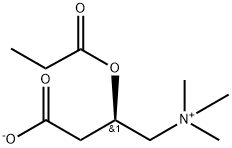
| Uses | L-Propionyl carnitine has been shown to improve the heart mechanical recovery and other metabolic parameters after ischemia-reperfusion | | Uses | Propionyl-L-carnitine was identified in the drinking water in rats. | | Uses | Propionyl-L-carnitine has been used as a standard in liquid chromatography-tandem mass spectrometry (LC-MS/MS). | | General Description | Propionyl-L-carnitine (PLC), a natural odd-carbon-number, endogenous ester of L-carnitine, is found to be present in humans and animals as a minor component compared to L-carnitine (LC) and acetyl-L-carnitine (ALC). It acts as a carrier of long chain acyl groups from activated fatty acids across the inner mitochondrial membrane into the mitochondrial matrix where they undergo β-oxidation to acetyl CoA to obtain usable energy via the citric acid cycle. | | Biochem/physiol Actions | Propionyl-L-carnitine (PLC) plays a key role in lipid and carbohydrate metabolism. It provides substrates to the ischemic muscle for energy production and ATP generation. PLC has the potential to treat severe peripheral arterial disease and chronic heart failure. It is present in high abundance in the urine of patients with methylmalonyl-CoA mutase (MUT) deficiency, together with methylmalonic acid. MUT is a mitochondrial enzyme that catalyzes the isomerization of methylmalonyl-CoA to succinyl-CoA. |
| PROPIONYL-L-CARNITINE HYDROCHLORIDE Preparation Products And Raw materials |
|


 日本语
日本语 한국어
한국어 Français
 Deutsch
 España
 Türkiye