Other grades of this product :
| L-Hexanoylcarnitine Basic information |
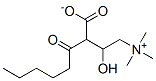
| Product Name: | L-Hexanoylcarnitine | | Synonyms: | L-Hexanoylcarnitine;HEXANOYL-L-CARNITINE;O-hexanoyl-L-carnitine;Hexanoyl-L-carnitine >=97.0% (TLC) | | CAS: | 22671-29-0 | | MF: | C13H25NO4 | | MW: | 0 | | EINECS: | | Product Categories: | | Mol File: | 22671-29-0.mol |
| L-Hexanoylcarnitine Chemical Properties |
| storage temp. | 2-8°C | | optical activity | [α]/D -21±2°, c = 1 in H2O |
| L-Hexanoylcarnitine Usage And Synthesis |
| Uses | Hexanoyl-L-carnitine may be used as an analytical reference standard for the quantification of the analyte in dried blood spots using high-performance liquid chromatography coupled to electrospray ionization tandem mass spectrometry (HPLC-ESI-MS/MS). Hexanoyl-L-carnitine may also be used as an analytical standard for the separation and identification of underivatized hexanoyl-L-carnitine in human plasma samples using HPLC-MS/MS. | | Definition | ChEBI: An O-hexanoylcarnitine that has L configuration. | | General Description | Hexanoyl-L-carnitine belongs to the class of straight-chain acylcarnitines, which are important biomarkers in the diagnosis of carnitine deficiency. | | Biochem/physiol Actions | Numerous disorders have been described that lead to disturbances in energy production and in intermediary metabolism in the organism which are characterized by the production and excretion of unusual acylcarnitines. A mutation in the gene coding for carnitine-acylcarnitine translocase or the OCTN2 transporter aetiologically causes a carnitine deficiency that results in poor intestinal absorption of dietary L-carnitine, its impaired re-absorption by the kidney and, consequently, in increased urinary loss of L-carnitine. Determination of the qualitative pattern of acylcarnitines can be of diagnostic and therapeutic importance. The betaine structure of carnitine requires special analytical procedures for recording. The ionic nature of L-carnitine causes a high water solubility which decreases with increasing chain length of the ester group in the acylcarnitines. Therefore, the distribution of L-carnitine and acylcarnitines in various organs is defined by their function and their physico-chemical properties as well. High performance liquid chromatography (HPLC) permits screening for free and total carnitine, as well as complete quantitative acylcarnitine determination, including the long-chain acylcarnitine profile. |
| L-Hexanoylcarnitine Preparation Products And Raw materials |
|


 日本语
日本语 한국어
한국어 Français
 Deutsch
 España
 Türkiye