Other grades of this product :
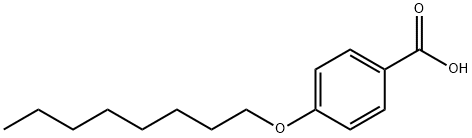
| 4-N-OCTYLOXYBENZOIC ACID Basic information |
| 4-N-OCTYLOXYBENZOIC ACID Chemical Properties |
| Melting point | 101-105 °C (lit.) | | Boiling point | 353.47°C (rough estimate) | | density | 1.0589 (rough estimate) | | refractive index | 1.5600 (estimate) | | storage temp. | Sealed in dry,Room Temperature | | solubility | almost transparency in hot Methanol | | pka | 4.48±0.10(Predicted) | | form | powder to crystal | | color | White to Almost white | | CAS DataBase Reference | 2493-84-7(CAS DataBase Reference) | | EPA Substance Registry System | p-(Octyloxy)benzoic acid (2493-84-7) |
| Safety Statements | 24/25 | | WGK Germany | 3 | | TSCA | Yes | | HS Code | 29189990 |
| 4-N-OCTYLOXYBENZOIC ACID Usage And Synthesis |
| Chemical Properties | White to light yellow crystal powder | | Uses | Intermediate for the synthesis of liquid crystals including chiral ferroelectric benzoates. Used in the preparation of medicinal compounds. | | General Description | White powder. | | Air & Water Reactions | Insoluble in water. | | Reactivity Profile | 4-N-OCTYLOXYBENZOIC ACID is a carboxylic acid. Carboxylic acids donate hydrogen ions if a base is present to accept them. They react in this way with all bases, both organic (for example, the amines) and inorganic. Their reactions with bases, called "neutralizations", are accompanied by the evolution of substantial amounts of heat. Neutralization between an acid and a base produces water plus a salt. Carboxylic acids with six or fewer carbon atoms are freely or moderately soluble in water; those with more than six carbons are slightly soluble in water. Soluble carboxylic acid dissociate to an extent in water to yield hydrogen ions. The pH of solutions of carboxylic acids is therefore less than 7.0. Many insoluble carboxylic acids react rapidly with aqueous solutions containing a chemical base and dissolve as the neutralization generates a soluble salt. Carboxylic acids in aqueous solution and liquid or molten carboxylic acids can react with active metals to form gaseous hydrogen and a metal salt. Such reactions occur in principle for solid carboxylic acids as well, but are slow if the solid acid remains dry. Even "insoluble" carboxylic acids may absorb enough water from the air and dissolve sufficiently in 4-N-OCTYLOXYBENZOIC ACID to corrode or dissolve iron, steel, and aluminum parts and containers. Carboxylic acids, like other acids, react with cyanide salts to generate gaseous hydrogen cyanide. The reaction is slower for dry, solid carboxylic acids. Insoluble carboxylic acids react with solutions of cyanides to cause the release of gaseous hydrogen cyanide. Flammable and/or toxic gases and heat are generated by the reaction of carboxylic acids with diazo compounds, dithiocarbamates, isocyanates, mercaptans, nitrides, and sulfides. Carboxylic acids, especially in aqueous solution, also react with sulfites, nitrites, thiosulfates (to give H2S and SO3), dithionites (SO2), to generate flammable and/or toxic gases and heat. Their reaction with carbonates and bicarbonates generates a harmless gas (carbon dioxide) but still heat. Like other organic compounds, carboxylic acids can be oxidized by strong oxidizing agents and reduced by strong reducing agents. These reactions generate heat. A wide variety of products is possible. Like other acids, carboxylic acids may initiate polymerization reactions; like other acids, they often catalyze (increase the rate of) chemical reactions. | | Fire Hazard | Flash point data for 4-N-OCTYLOXYBENZOIC ACID are not available, however 4-N-OCTYLOXYBENZOIC ACID is probably combustible. |
| 4-N-OCTYLOXYBENZOIC ACID Preparation Products And Raw materials |
|


 日本语
日本语 한국어
한국어 Français
 Deutsch
 España
 Türkiye