Other grades of this product :
| POLY(ETHYLENE TEREPHTHALATE) Basic information |
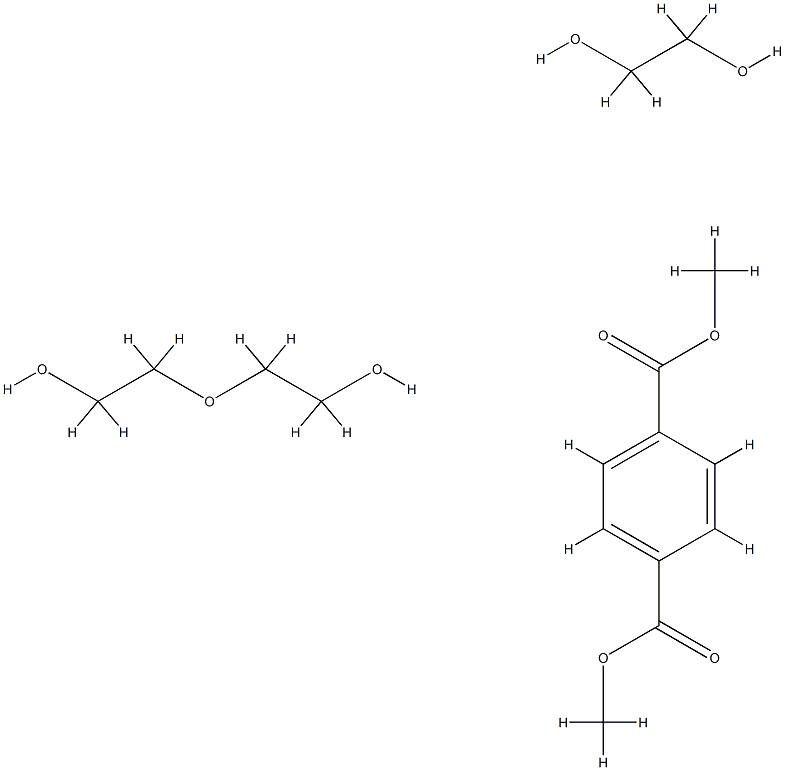
| Product Name: | POLY(ETHYLENE TEREPHTHALATE) | | Synonyms: | 1,4-Benzenedicarboxylicacid,dimethylester,polymerwith1,2-ethanedioland2,2’-oxybis[ethanol];Diethyleneglycol,ethyleneglycol,dimethylterephthalatepolymer;DIMETHYL TEREPHTHALATE-DIETHYLENE GLYCOL-ETHYLENE GLYCOL POLYMER;polyethylene terephthalate copolymer resin;POLY(ETHYLENE GLYCOL TEREPHTHALATE);POLY(ETHYLENE TEREPHTHALATE) | | CAS: | 29154-49-2 | | MF: | C16H26O9 | | MW: | 362.37224 | | EINECS: | | Product Categories: | | Mol File: | 29154-49-2.mol |
| POLY(ETHYLENE TEREPHTHALATE) Chemical Properties |
| Hazard Codes | Xi | | Risk Statements | 36/37/38 | | Safety Statements | 26-36 | | WGK Germany | 3 | | RTECS | TR2725000 |
| POLY(ETHYLENE TEREPHTHALATE) Usage And Synthesis |
| Chemical Properties | Poly(ethylene terephthalate) is a colourless rigid substance. Because of its
structural regularity, the polymer readily crystallizes and the physical properties of the bulk material are greatly affected by the extent of crystallinity,
which, in turn, is largely determined by the previous history of the material.
In the production of fibre, the molten polymer is extruded through spinnerets
into air at normal temperature. The filaments are thus rapidly cooled and are
largely amorphous and are weak. The filaments are then drawn at a temperature
above the glass-transition temperature (80°C), whereby molecular
orientation and crystallinity are induced. Finally, the filaments are heated at
about 200°C under tension to give a dimensionally-stable material of
maximum crystallinity. The manufacture of poly(ethylene terephthalate) film
closely resembles that of fibre and also involves extrusion, orientation and
stabilization. | | Uses | Poly(butylene terephthalate) is used as an engineering material in a variety
of applications which include automotive parts, electrical components and
domestic appliance assemblies. | | Preparation | It is prepared from 1,4-butanediol and terephthalic acid or dimethylterephthalate by processes which are essentially the same as those used for poly(ethylene terephthalate) and described in the preceding section. Due to the longer sequence of methylene groups, the polymer chains are more flexible and less polar than in poly(ethylene terephthalate). This results in a lower crystalline melting point (225°C) and glass-transition point (22-43°C). The low glass-transition temperature facilitates rapid crystallization in the mould and most poly(butylene terephthalate) is processed by injection moulding. | | Industrial uses | Polyethylene terephthalate is a useful materialthat has good resistance to acids and alkalisprovided that they are diluted. It is insoluble inmany common solvents, although it does dissolvein aromatic and chlorinated hydrocarbons,especially when warm. It softens above250°C. |
| POLY(ETHYLENE TEREPHTHALATE) Preparation Products And Raw materials |
|


 日本语
日本语 한국어
한국어 Français
 Deutsch
 España
 Türkiye