Other grades of this product :
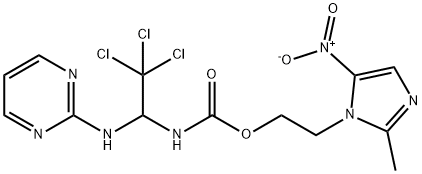
| Product Name: | Apcin | | Synonyms: | Apcin;3-(2-Methyl-5-nitroimidazol-1-yl)-N-(2,2,2-trichloro-1-phenylaminoethyl)propionamide;Carbamic acid, [2,2,2-trichloro-1-(2-pyrimidinylamino)ethyl]-, 2-(2-methyl-5-nitro-1H-imidazol-1-yl)ethyl ester (9CI);Apcin >=98% (HPLC);2-(2-methyl-5-nitro-1H-imidazol-1-yl)ethyl 2,2,2-trichloro-1-(pyrimidin-2-ylamino)ethylcarbamate;2-(2-Methyl-5-nitro-1H-imidazol-1-yl)ethyl N-{2,2,2-trichloro-1-[(pyrimidin-2-yl)amino]ethyl}carbamate | | CAS: | 300815-04-7 | | MF: | C13H14Cl3N7O4 | | MW: | 438.65 | | EINECS: | | Product Categories: | | Mol File: | 300815-04-7.mol |
| Apcin Chemical Properties |
| density | 1.68±0.1 g/cm3(Predicted) | | storage temp. | room temp | | form | powder | | pka | 9.67±0.46(Predicted) | | color | white to beige |
| Apcin Usage And Synthesis |
| Uses | Apcin is a novel inhibitor of the anaphase-promoting complex/cyclosome (APC/C), blocking mitotic exit and being synergistically amplified by co-addition of Ts-Arg-OMe. | | Biochem/physiol Actions | Apcin is an inhibitor of the anaphase-promoting complex/cyclosome (APC/C), a large multimeric complex that functions as a ubiquitin ligase, initiating the metaphase–anaphase transition and regulating ordered transitions through the cell cycle by controlling the ubiquitin-mediated proteolysis of cell cycle proteins. Apcin prevents substrate recognition and inhibits APC/C-dependent ubiquitylation by binding to the D-box binding site of Cdc20, a coactivator required for full activation of APC/C and substrate recognition. The effectiveness of apcin in blocking mitotic exit was synergistically amplified by co-addition of TAME (tosyl-L-arginine methyl ester) or its cell permeable prodrug proTAME, which block Cdc20 binding to the APC/C at a different site than apcin. | | Enzyme inhibitor | This Cdc20 inhibitor (FW = 438.65 g/mol; CAS 300815-04-7; Solubility: 100 mM in DMSO), also named 3-(2-methyl-5-nitroimidazol-1-yl)-N- (2,2,2-trichloro-1-phenylaminoethyl)propionamide, targets substrate interaction of Cell division control protein 20, blocking substrate-mediated Cdc20 loading onto the Anaphase-Promoting Complex. APC is a 13- subunit ubiquitin ligase that initiates the metaphase-anaphase transition and mitotic exit by targeting proteins such as securin and cyclin B1 for ubiquitin-dependent destruction by the proteasome. APC regulates cell cycle progression by forming APC·Cdc20 and APC·Cdh1, two closely related, but functionally distinct, E3 ubiquitin ligase sub-complexes. Cdh1 and Cdc20 have opposing functions in tumorigenesis, with the former largely functioning as a tumor suppressor, and the latter exhibiting an oncogenic function. Because blocking mitotic exit is an effective approach for inducing tumour cell death, the APC/C represents a potential novel target for cancer therapy. APC/C activation during mitosis requires Cdc20binding, forming a co-receptor with the APC/C to recognize substrates containing a destruction box (D-box). APC/C-dependent proteolysis and mitotic exit can be synergistically inhibited by simultaneously disrupting two protein-protein interactions within the APC/C-Cdc20-substrate ternary complex. APC inhibitor, or Apcin, binds to Cdc20, competitively inhibiting ubiquitylation of D-box-containing substrates. Analysis of the crystal structure of the apcin-Cdc20 complex suggests that apcin occupies the D-box-binding pocket on the side face of the WD40-domain. The ability of Apcin to block mitotic exit is enhanced by co-addition of tosyl-l-arginine methyl ester (See TAME), a small molecule that blocks the APC/C-Cdc20 interaction. Apcin also inhibits APC-dependent ubiquitylation and prolongs mitotic duration in RPE1 cells, when administered in combination with proTAME, a prodrug of TAME in vitro (See pro-TAME). |
| Apcin Preparation Products And Raw materials |
|


 日本语
 한국어
 Français
 Deutsch
 España
 Türkiye